Unknown's avatar

Children’s books must be diverse, or kids will grow up believing white is superior


Shutterstock

Helen Joanne Adam, Edith Cowan University; Caroline Barratt-Pugh, Edith Cowan University; Libby Jackson-Barrett, Edith Cowan University, and Robert Stanly Somerville, Edith Cowan University

Global support for the Black Lives Matter movement isn’t only about standing up against the injustice done to George Floyd, or Indigenous Australians in custody. People are also standing up against the entrenched racism that leads to a careless approach towards the lives of people who aren’t white.

Research shows 75% of Australians hold an implicit bias against Indigenous Australians, seeing them negatively, even if this is unconscious. Children absorb this bias, which becomes entrenched due to messages in the media and in books, and continues to play out at school and the broader community.

Making sure children have access to books showing diversity is one step in breaking the cycle that leads to entrenched racism.

Children develop bias from an early age

Children develop their sense of identity and perceptions of others from a very early age – as early as three months old. Because of this, young children are particularly vulnerable to the messages they see and hear in the media and in books.

Research over many years has shown books can empower, include and validate the way children see themselves. But books can also exclude, stereotype and oppress children’s identities. Minority groups are particularly at risk of misrepresentation and stereotyping in books.

First Nations groups are commonly absent from children’s books. Excluding the viewpoints, histories and suffering of First Nations Peoples can misrepresent history, and teach kids a white-washed version of the past.


Read more:
Captain Cook ‘discovered’ Australia, and other myths from old school text books


A world of children’s books dominated by white authors, white images and white male heroes, creates a sense of white superiority. This is harmful to the worldviews and identities of all children.

Sharing stories through books

Evidence shows sharing Aboriginal and Torres Strait Islander stories helps break down stereotypes and prejudice. And this, importantly, helps empower Aboriginal children and improve their educational engagement and outcomes.

But research suggests many classrooms have books that are monocultural literature, and Aboriginal and Torres Strait Islander books are notably absent.

There are some encouraging signs, with an increase in the publication of books by and about Aboriginal and Torres Strait Islander peoples. We are also seeing bookshops and publishers reporting a rise in demand for books on race and racism.
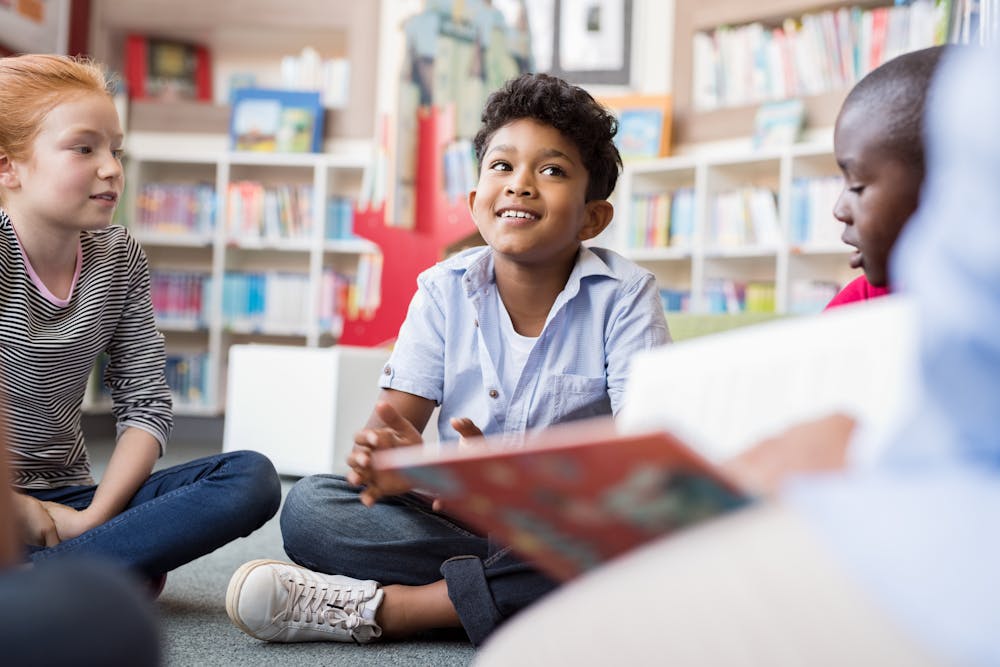
Books can empower and validate children’s identities. But they can also make them feel inferior.
Shutterstock

This can also help adults become informed about Australia’s colonial history. Reading these books can help challenge their own unconscious biases and misunderstandings.


Read more:
Bias starts early – most books in childcare centres have white, middle-class heroes


The challenge for teachers and parents is to access suitable children’s books and share them with the children in their care. We can use these stories as a foundation for conversations about culture and community.

This can help to drive change and support reconciliation.

Other ways of sharing diverse stories

Creating Books in Communities is a pilot project run by the State Library of Western Australia that helps create books with families about their everyday experiences. These books represent the families’ culture and language.

Projects like these are another way we can recognise and extend the voices of Aboriginal and Torres Strait Islander peoples.

Another project, On Country Learning, involves children and teachers learning through culture alongside Aboriginal elders. A preliminary review of the program shows it enriches teacher knowledge and motivates all children to learn.

Reading and listening to the stories of Aboriginal and Torres Strait Islander peoples can help teachers gain important knowledge and understanding. This helps them effectively engage with and teach Aboriginal and Torres Strait Islander students.


Read more:
9 tips teachers can use when talking about racism


And it helps them teach all students about Aboriginal and Torres Strait Islander languages, histories and cultures.

To see real and lasting change children need everyday story books with heroes and characters that reflect their diverse backgrounds. To help this happen we can support groups such as the We Need Diverse Books Movement and LoveOZYA , which actively call for and promote diverse books for young people.

Affirmation of all children’s culture, language and identity at this pivotal time in world history is critical to the future of all our children.

Parents and teachers can source Aboriginal literature from websites such as: Magabala Books, IAD Press, Aboriginal Studies Press, Fremantle Press, UWA Publishing, BlackWords, Batchelor Institute Press.The Conversation

Helen Joanne Adam, Senior Lecturer in Literacy Education and Children’s Literature: Course Coordinator Master of Teaching (Primary), Edith Cowan University; Caroline Barratt-Pugh, Professor of Early Childhood, Edith Cowan University; Libby Jackson-Barrett, Senior Lecturer, Edith Cowan University, and Robert Stanly Somerville, Head of Teaching and Learning, Kurongkurl Katitjin Centre for Australian Indigenous Education and Research, Associate Professor, Edith Cowan University

This article is republished from The Conversation under a Creative Commons license. Read the original article.
Unknown's avatar

Five tips to make school bookshelves more diverse and five books to get you started


File 20190206 174870 jvlpna.jpg?ixlib=rb 1.1
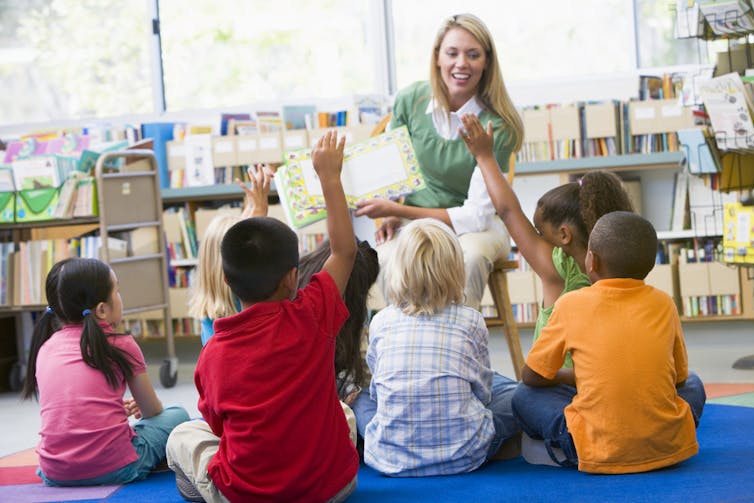
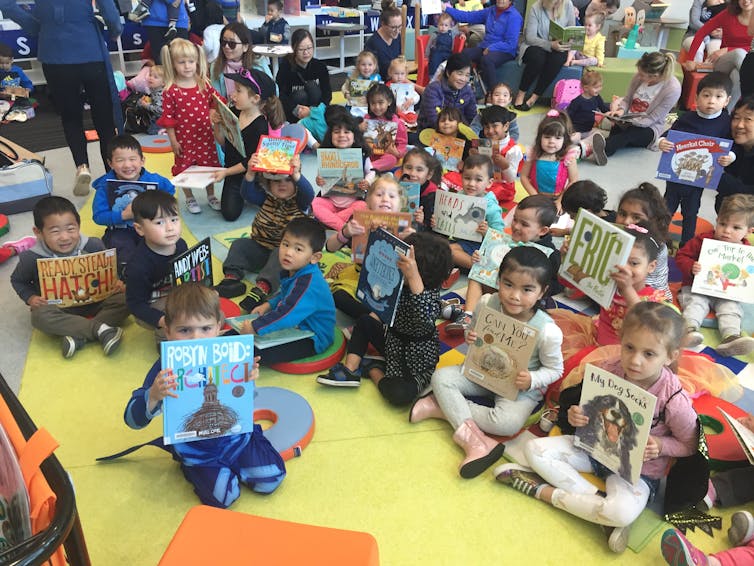
Children need to be able to see themselves in the books they read.
Cockburn Libraries/flickr, CC BY-NC-ND

Helen Joanne Adam, Edith Cowan University

A lack of diverse books is failing children from minority backgrounds. This is something that should concern all Australians.

I studied five Australian early learning settings and found less than 5% of books contained cultural diversity. My more recent findings show educators are struggling to use books in ways that promote intercultural understandings.


Read more:
Eight Australian picture books that celebrate family diversity


Diverse books can help achieve principles of diversity written into Australian education polices. The potential of diverse books in addressing these principles and equity more generally is too important to ignore.

How books impact little readers socially and academically

Reading to children has a powerful impact on their academic and intellectual development. Children learn about themselves and the world through the books they’re exposed to. Importantly, children can learn understanding and respect for themselves and for those who are different to them.

The majority of children’s books depict white main characters.
Photo by Hello I’m Nik on Unsplash, CC BY

But a lack of diverse books means we have a serious problem. Currently, children from minority backgrounds rarely see themselves reflected in the books they’re exposed to. Research over the last two decades shows the world presented in children’s books is overwhelmingly white, male and middle class.

For children from minority groups, this can lead to a sense of exclusion. This can then impact on their sense of identity and on their educational and social outcomes.

Stereotypes and misrepresentation

The evidence regarding Indigenous groups across the world is even more alarming. Research shows these groups are rarely represented. And, if represented at all, are most likely to be represented in stereotypical or outdated ways.

Many educators or adults unwittingly promote stereotypical, outdated or exotic views of minority groups. This can damage the outcomes for children from those groups. Children from dominant cultural groups can view themselves as “normal” and “others” as different.


Read more:
How children’s picturebooks can disrupt existing language hierarchies


In my recent study, I found the book collections in early childhood settings were overwhelmingly monocultural. Less than 5% of the books contained any characters who were not white. And in those few books, the minority group characters played a background role to a white main character.

Particularly concerning was the lack of representation of Aboriginal and Torres Strait Islander people. Of 2,377 books, there were only two books available to children that contained Aboriginal and Torres Strait Islander characters. Only one of these was a story book.

In this book, the Aboriginal character was portrayed as a semi-naked person playing a didgeridoo in the outback. There were no books showing actual everyday lifestyles or views of Aboriginal people.

Teachers are uncertain

The accompanying practice of teachers may also be counterproductive to achieving equitable outcomes for children from minority backgrounds. The teachers in my study were keen and committed to the children in their care. They were passionate about the importance of reading to children. But when it came to selecting books, they struggled to know what books to select and how best to use them.

Teachers also need support to learn how to select diverse books.
from http://www.shutterstock.com

Other research has found similar uncertainty among teachers. Some teachers overlooked the importance of diversity altogether. Some saw diversity as a special extra to address occasionally rather than an essential part of everyday practice.

How can we make bookshelves more diverse?

The call for more diverse booksfor children is gaining momentum around the world. The value of diverse books for children’s educational, social and emotional outcomes is of interest to all.

The voices of Aboriginal and minority group writers calling for change are gaining momentum. But there is still much to be done.

The recent development of a database from the National Centre for Australian Children’s Literacy is an important step. Publications of diverse books are still very much in the minority but some awareness and promotion of diverse books is increasing.

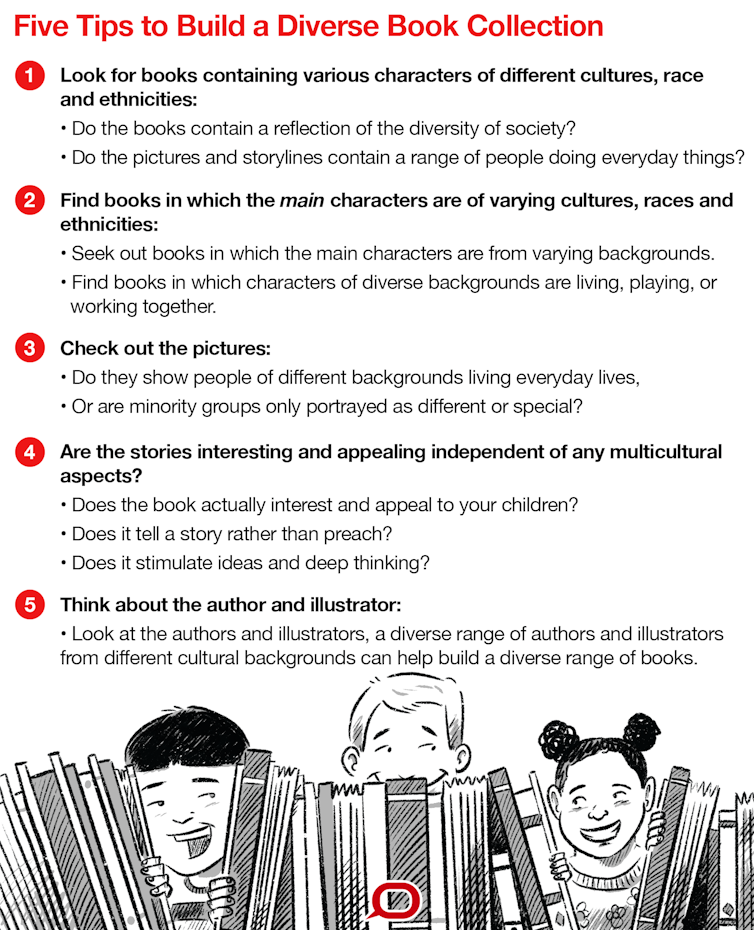
These important steps forward could be supported with better training for teachers and increased discussion among those who write, publish and source books for children. Here are five tips to help you build a more diverse book collection.


The Conversation, CC BY-ND

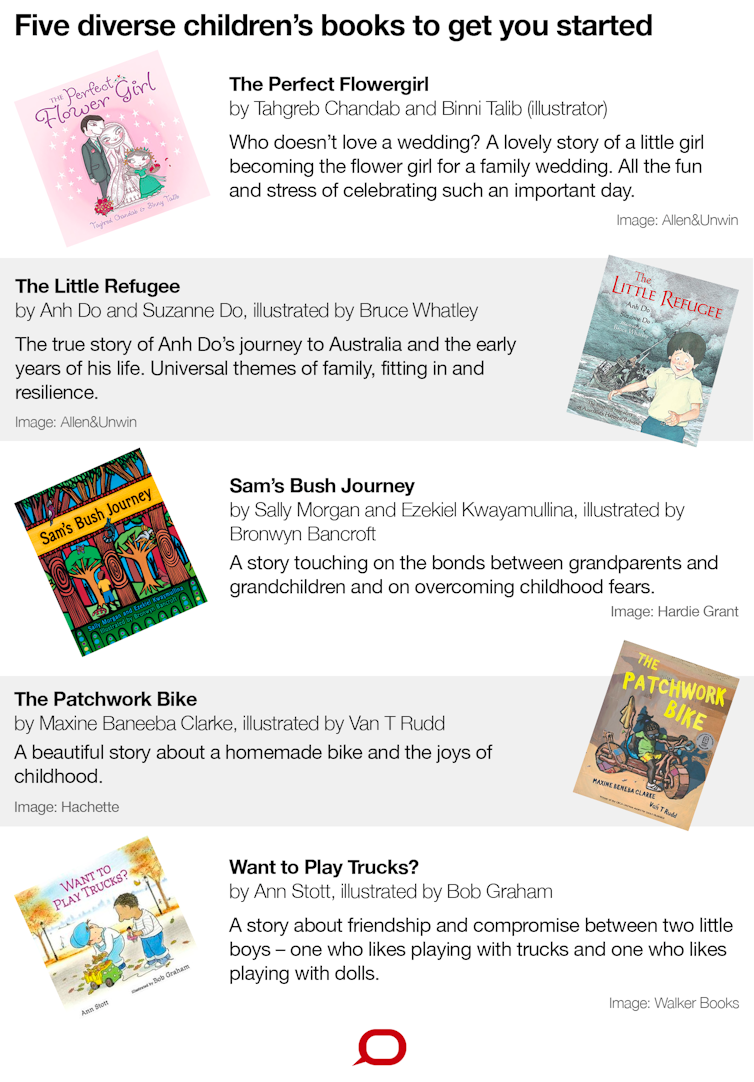
Educators and parents can strive to create libraries of inclusive books. This can ensure every child has the opportunity to achieve the substantial benefits we know books can bring. Here are five book titles to get you started on building a more diverse collection of books.


The Conversation, CC BY-ND

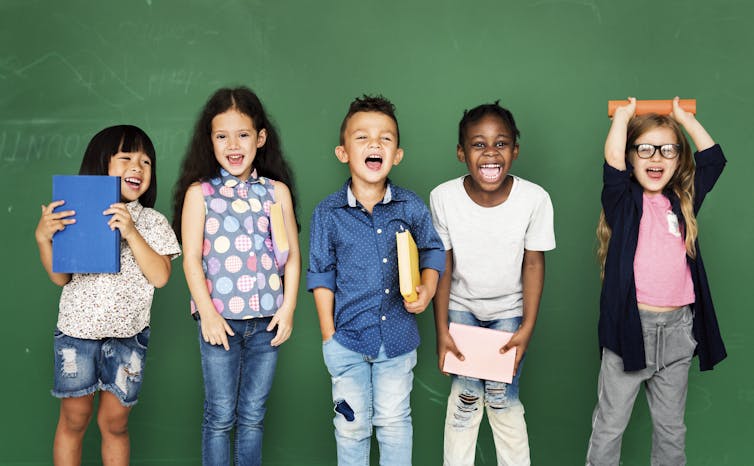
When we share diverse books with children, they gain opportunities to see themselves reflected and affirmed. Importantly we broaden children’s perspectives and understandings of those that are different to themselves.


Read more:
Telling the real story: diversity in young adult literature


This supports children to value others as unique and equal individuals.
Inclusive book collections which depict and affirm a diverse range of children, will contribute to equitable outcomes for all children.The Conversation

Helen Joanne Adam, Lecturer in Literacy Education and Children’s Literature, Edith Cowan University

This article is republished from The Conversation under a Creative Commons license. Read the original article.