Unknown's avatar

Five great reads to help teens become critical thinkers


File 20171212 9404 1vk4zo3.jpg?ixlib=rb 1.1
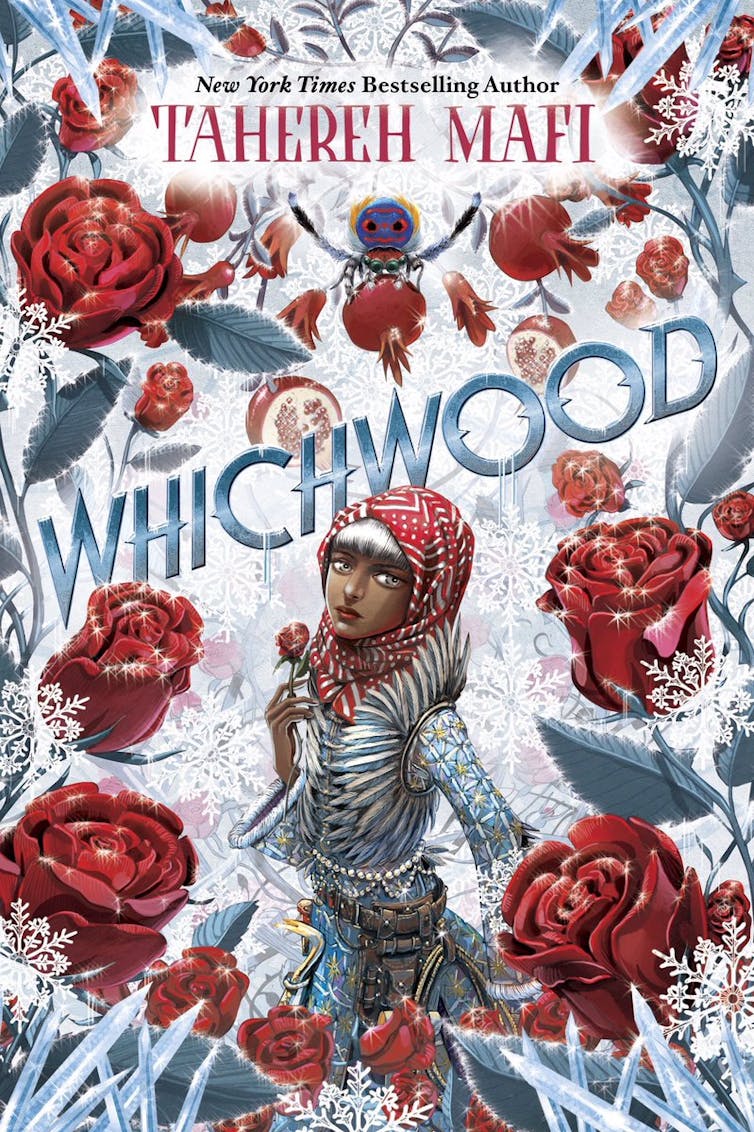
Whichwood is one of five great reads for teens that highlight authentic experiences, marginalized voices and critical thinking.
(Dutton Books)

Heba Elsherief, University of Toronto

Young adults who are, perhaps, still figuring out their needs don’t need to be overburdened with books they won’t like. The last thing we want is for a young reader to get turned off and lose out on the immeasurable benefits reading provides.

As a researcher looking at diverse representations in young adult literature, I often get asked for book recommendations.

Since I believe all readers are looking for an emotional connection to a story, I start with authenticity as my keystone. In order to form a connection with the experiences of characters, including their travel and journeys to new places, the writing should emerge from a place of authenticity.

Diversity plus critical issues

Author Corinne Duyvis started the hashtag #Ownvoices in 2015 to promote this idea of authenticity and “to recommend kidlit about diverse characters written by authors from that same diverse group.”

Very basically, when an author shares one or more of the marginalities of their diverse protagonists, it is considered to be included in #Ownvoices. In terms of diversity, most publishers use the definition put out by We Need Diverse Books: “…including (but not limited to) LGBTQIA, Native, people of colour, gender diversity, people with disabilities, and ethnic, cultural, and religious minorities.”

The hashtag has taken on a life of its own since Duyvis recommended its use. Many published books now market themselves based on #Ownvoices. And Goodreads lists have taken up this call as well. Readers looking for #OwnVoices will find many suggestions – and many more coming in the new year.

I hope this is a turn in publishing and that the well of marginalized stories written by authors most qualified to tell them never runs dry. It’s the surest way to an authentic, empathy-promoting experience for readers.

The current Top Five

Many of the teachers or parents asking for recommendations are hoping to give young adult readers an exercise in critical literacy to provide them with the opportunity to think about something long after the final page is turned. By “something,” I mean an important social issue or nuanced knowledge about a difficult concept or historical time period.

If a book meets both of these criteria — and if I’ve read it myself or have placed it on my “to be read” shelf — it warrants a recommendation.

Here are five books, very recently published (between September and December of 2017), that have made my list. At the end of each book description, I’ve included a question that might serve a critical thinking discussion once the book has been read.

This list is clearly not exhaustive and I present these as suggestions — ones that may warrant further research. Teachers or parents who know the readers they’re offering books to may need to look up any trigger warnings beforehand.

I recommend adults read books along with younger readers: It’s vital to meaningful conversations. I have left questions in my descriptions to prompt some discussion. Furthermore, I think adult readers may be pleasantly surprised with the rich and important storytelling happening in the young adult literary world.

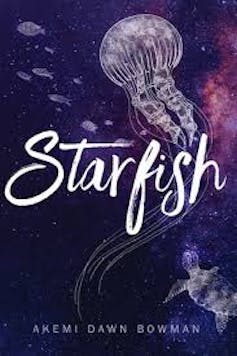
Starfish by Akemi Dawn Bowman
Starfish.
(Simon Pulse)

Starfish (Simon Pulse) features Kiko, who suffers from anxieties. She’s waiting to escape an abusive family situation by getting into the art school of her dreams but when she doesn’t get in, she takes the opportunity presented by a childhood friend to tour other schools.

Kiko, the main character who is half-Japanese, takes a journey that ends up being one of personal growth. The journey allows Kiko to embrace who she is, to learn more about her heritage and to speak up for herself. The writing is lyrical and endearing and we get a lot of Kiko’s internal thoughts and feelings.

There’s a love story here too. I would have liked it if Kiko’s path to self-love was not so knotted up with her childhood friend. But perhaps that’s me being old and young adult readers will like this aspect the best. What will you and your young adult readers think?

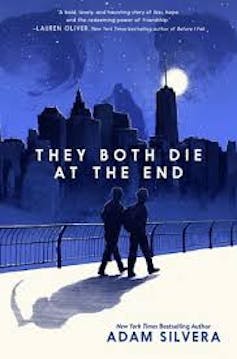
They Both Die at the End by Adam Silvera
They Both Die at the End.
(Harper Collins)

They Both Die at the End (Harper Collins) is an interesting genre mashup — both speculative and contemporary. With the whole “there’s an app for that” times we live in, it feels very timely.

In an alternate reality, two teen boys spend a day together after learning it will be their last. There’s diverse representation here and definitely a message that seems suitable for young people attached to their phones at the expense of experiencing the world and making real connections.

In my literature classes, we talk a lot about how classic children’s books tend to have “didactic” elements – morals embedded into them and modes of socialization or teaching children how to be in the world. Thinking through themes a writer develops, how do contemporary didactic modes operate here or in young adult literature more generally?

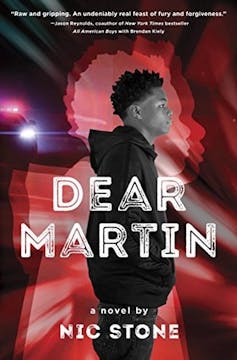
Dear Martin by Nic Stone
Dear Martin.
(Crown Books)

Dear Martin (Crown Books) takes up the story of Justyce McAllister, a full-scholarship, Ivy League-bound, Black 17-year-old boy who learns that when it comes to racism, none of these accomplishments matter.

The title takes its name from the letters Justyce writes to Martin Luther King, Jr. while he grapples with racial tensions and police oppression. It’s a story that seems ripped straight from the headlines and has been compared to The Hate U Give, this year’s very successful YA book by Angie Thomas. Both of these books are important and necessary, and sadly, deal with inequalities that plague young adults of colour. How can literature combat systematic oppression and social ills?

Warcross by Marie Lu
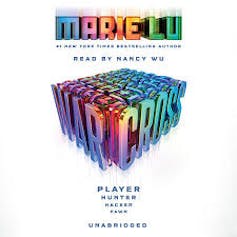
Warcross.
G.P. Putnam’s Sons Books for Young Readers

Warcross (G.P. Putnam’s Sons Books for Young Readers) has already wracked up a record number of positive reviews from readers. It’s a new series by the author of other YA favourites, including The Young Elites series.

In it, teenage hacker Emika Chen finds herself embroiled in a virtual reality game that’s taken over the globe. It’s an international spy adventure with a diverse cast in a near-future sci-fi world and it’s pretty awesome!

I think this one will organically prompt a discussion about “global virtual crazes” – and while its clear these virtual crazes might be ‘bad’ I wonder if there are positives to be found also?

Whichwood by Tahera Mafi
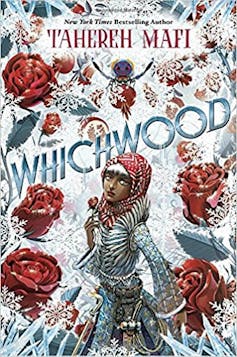
Whichwood.
(Dutton Books)

Whichwood (Dutton Books for Young Readers) is the second book set in the Furthermore world. The first was a middle grade book but this one has been aged up to Young Adult. Inspired by Mafi’s Persian culture, it tells the story of Laylee, a 15-year-old with so much tragedy in her life, tasked with washing bodies of the dead to prepare them for the afterlife.

The ConversationI’ve long been a fan of Mafi’s — her writing is lush and her worlds are so imaginative. Moreover, it always feels like everything she writes is a metaphor for something larger. But because her plots are so gripping, it’s not always apparent what exactly. Notwithstanding that themes in literature vary depending on individual reader’s responses to content, what do your readers find are the takeaways in this one?

Heba Elsherief, PhD Candidate, Language and Literacies Education, University of Toronto

This article was originally published on The Conversation. Read the original article.
Unknown's avatar

Why We Reread Books


Unknown's avatar

For baby’s brain to benefit, read the right books at the right time


File 20171209 27683 qnf9a7.jpg?ixlib=rb 1.1
How can you maximize reading’s rewards for baby?
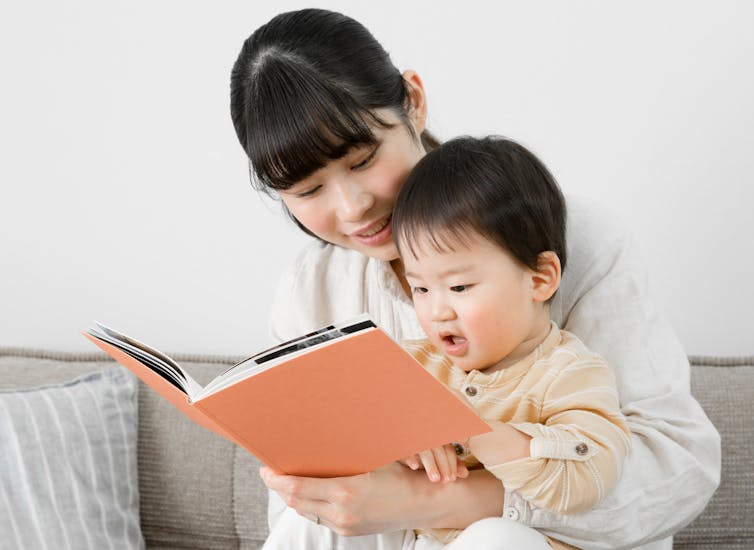
aijiro/Shutterstock.com

Lisa S. Scott, University of Florida

Parents often receive books at pediatric checkups via programs like Reach Out and Read and hear from a variety of health professionals and educators that reading to their kids is critical for supporting development.

The pro-reading message is getting through to parents, who recognize that it’s an important habit. A summary report by Child Trends, for instance, suggests 55 percent of three- to five-year-old children were read to every day in 2007. According to the U.S. Department of Education, 83 percent of three- to five-year-old children were read to three or more times per week by a family member in 2012.

What this ever-present advice to read with infants doesn’t necessarily make clear, though, is that what’s on the pages may be just as important as the book-reading experience itself. Are all books created equal when it comes to early shared-book reading? Does it matter what you pick to read? And are the best books for babies different than the best books for toddlers?

In order to guide parents on how to create a high-quality book-reading experience for their infants, my psychology research lab has conducted a series of baby learning studies. One of our goals is to better understand the extent to which shared book reading is important for brain and behavioral development.

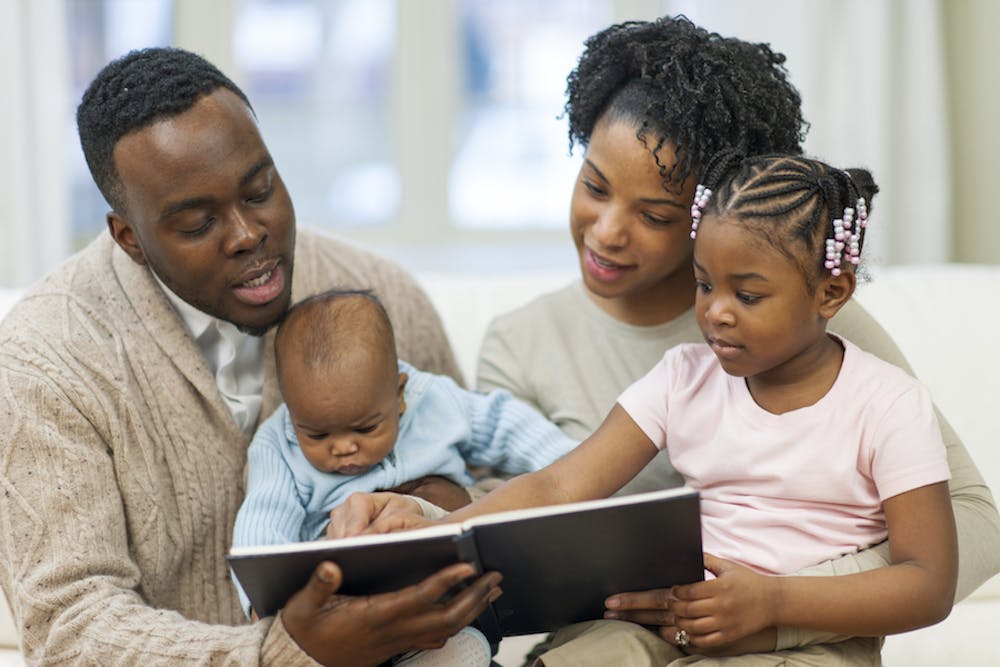
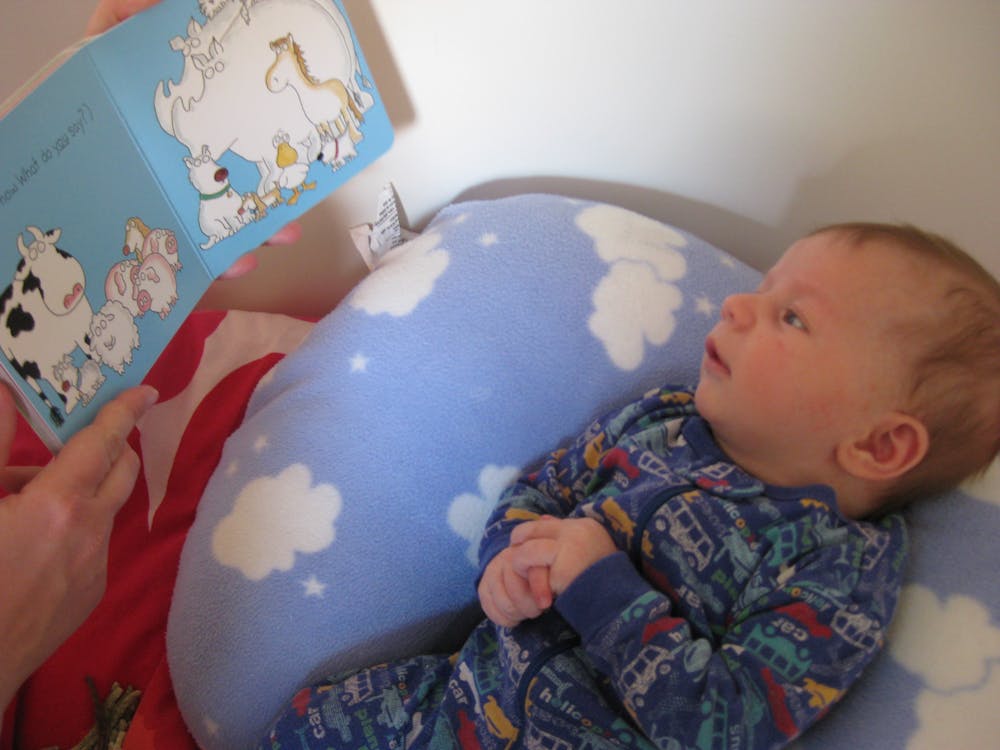
Even the littlest listeners can enjoy having a book read to them.
Maggie Villiger, CC BY-ND

What’s on baby’s bookshelf

Researchers see clear benefits of shared book reading for child development. Shared book reading with young children is good for language and cognitive development, increasing vocabulary and pre-reading skills and honing conceptual development.

Shared book reading also likely enhances the quality of the parent-infant relationship by encouraging reciprocal interactions – the back-and-forth dance between parents and infants. Certainly not least of all, it gives infants and parents a consistent daily time to cuddle.

Recent research has found that both the quality and quantity of shared book reading in infancy predicted later childhood vocabulary, reading skills and name writing ability. In other words, the more books parents read, and the more time they’d spent reading, the greater the developmental benefits in their 4-year-old children.

This important finding is one of the first to measure the benefit of shared book reading starting early in infancy. But there’s still more to figure out about whether some books might naturally lead to higher-quality interactions and increased learning.

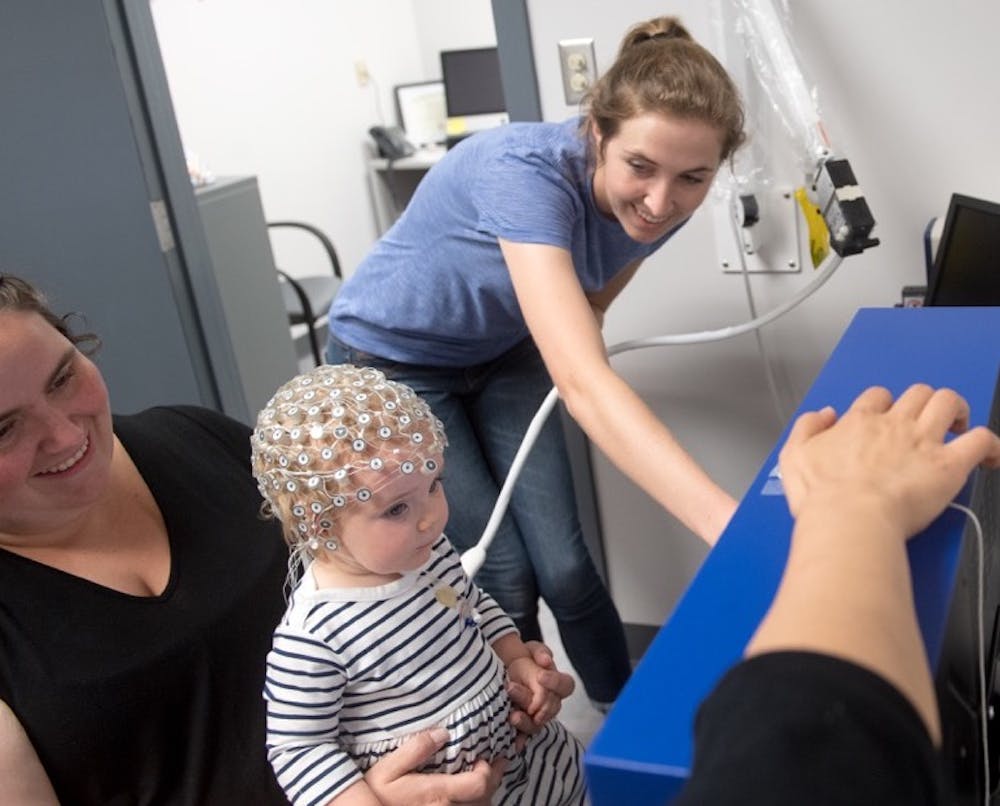
EEG caps let researchers record infant volunteers’ brain activity.
Matthew Lester, CC BY-ND

Babies and books in the lab

In our investigations, my colleagues and I followed infants across the second six months of life. We’ve found that when parents showed babies books with faces or objects that were individually named, they learn more, generalize what they learn to new situations and show more specialized brain responses. This is in contrast to books with no labels or books with the same generic label under each image in the book. Early learning in infancy was also associated with benefits four years later in childhood.

Our most recent addition to this series of studies was funded by the National Science Foundation and just published in the journal Child Development. Here’s what we did.

First, we brought six-month-old infants into our lab, where we could see how much attention they paid to story characters they’d never seen before. We used electroencephalography (EEG) to measure their brain responses. Infants wear a cap-like net of 128 sensors that let us record the electricity naturally emitted from the scalp as the brain works. We measured these neural responses while infants looked at and paid attention to pictures on a computer screen. These brain measurements can tell us about what infants know and whether they can tell the difference between the characters we show them.

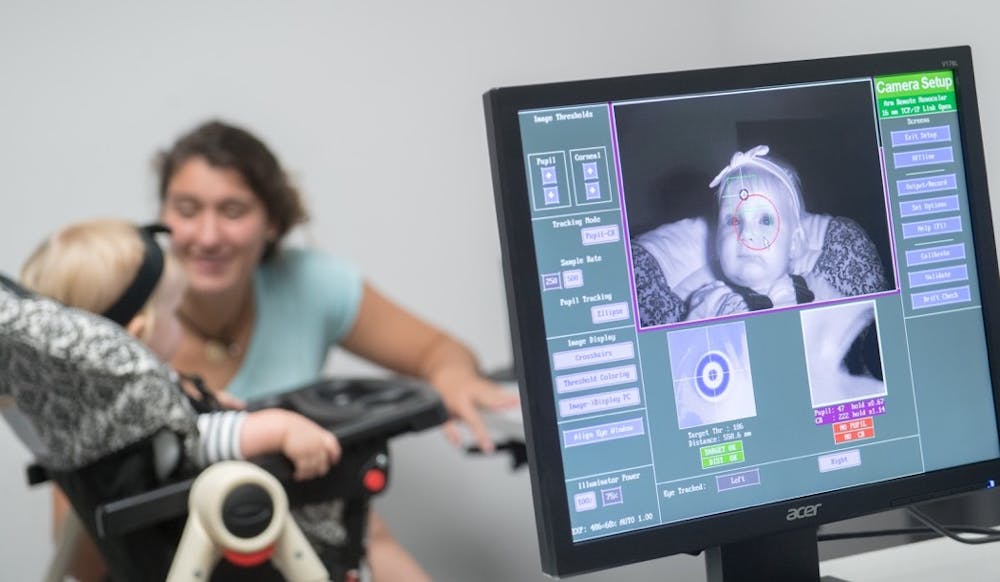
We also tracked the infants’ gaze using eye-tracking technology to see what parts of the characters they focused on and how long they paid attention.

Eye-tracking setups let researchers monitor what infants are paying attention to.
Matthew Lester, CC BY-ND

The data we collected at this first visit to our lab served as a baseline. We wanted to compare their initial measurements with future measurements we’d take, after we sent them home with storybooks featuring these same characters.

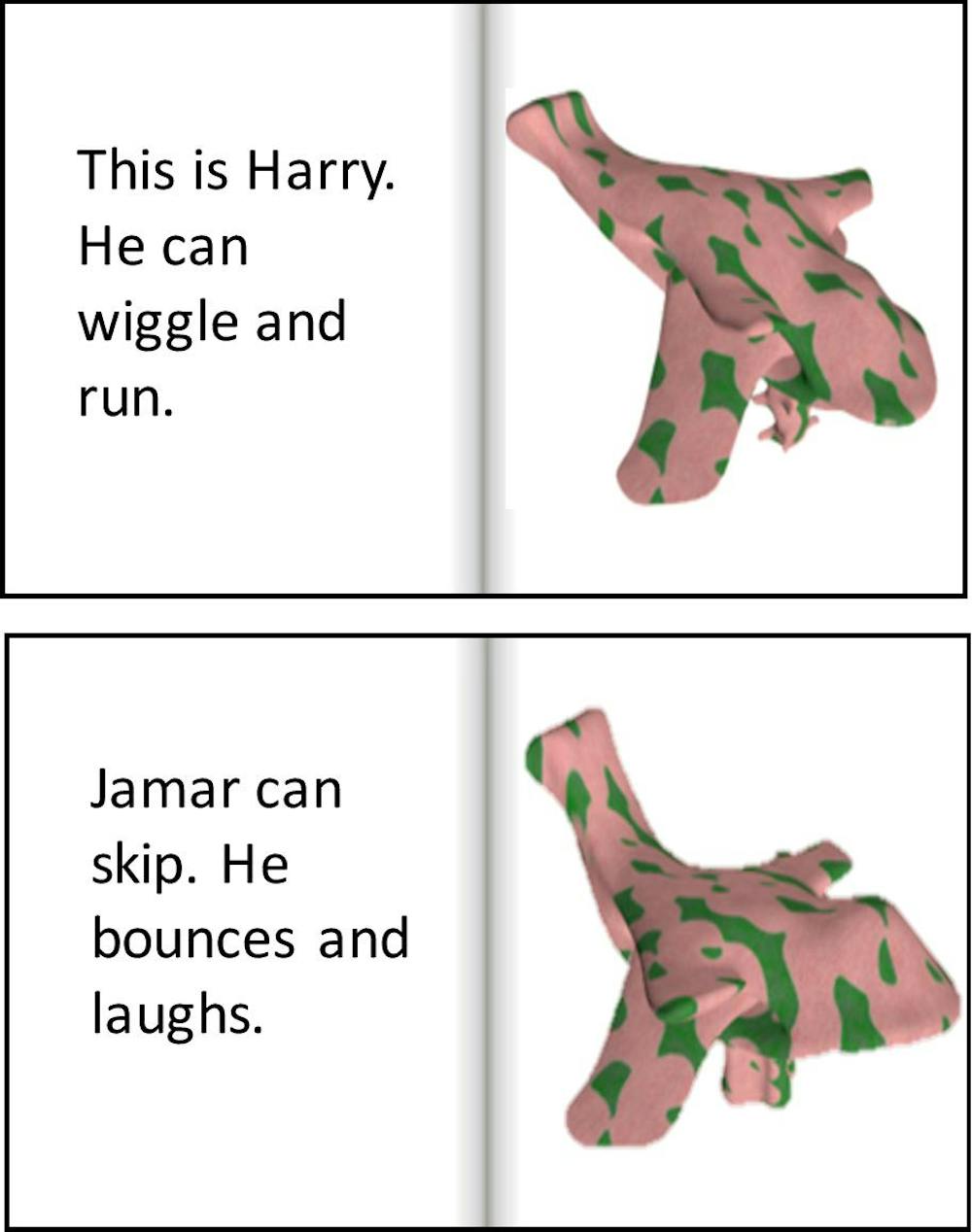
Example of pages from a named character book researchers showed to baby volunteers.
Lisa Scott

We divided up our volunteers into three groups. One group of parents read their infants storybooks that contained six individually named characters that they’d never seen before. Another group were given the same storybooks but instead of individually naming the characters, a generic and made-up label was used to refer to all the characters (such as “Hitchel”). Finally, we had a third comparison group of infants whose parents didn’t read them anything special for the study.

After three months passed, the families returned to our lab so we could again measure the infants’ attention to our storybook characters. It turned out that only those who received books with individually labeled characters showed enhanced attention compared to their earlier visit. And the brain activity of babies who learned individual labels also showed that they could distinguish between different individual characters. We didn’t see these effects for infants in the comparison group or for infants who received books with generic labels.

These findings suggest that very young infants are able to use labels to learn about the world around them and that shared book reading is an effective tool for supporting development in the first year of life.

Best book choices vary as kids grow.
Penn State, CC BY-NC-ND

Tailoring book picks for maximum effect

So what do our results from the lab mean for parents who want to maximize the benefits of storytime?

Not all books are created equal. The books that parents should read to six- and nine-month-olds will likely be different than those they read to two-year-olds, which will likely be different than those appropriate for four-year-olds who are getting ready to read on their own. In other words, to reap the benefits of shared book reading during infancy, we need to be reading our little ones the right books at the right time.

For infants, finding books that name different characters may lead to higher-quality shared book reading experiences and result in the learning and brain development benefits we find in our studies. All infants are unique, so parents should try to find books that interest their baby.

My own daughter loved the “Pat the Bunny” books, as well as stories about animals, like “Dear Zoo.” If names weren’t in the book, we simply made them up.

The ConversationIt’s possible that books that include named characters simply increase the amount of parent talking. We know that talking to babies is important for their development. So parents of infants: Add shared book reading to your daily routines and name the characters in the books you read. Talk to your babies early and often to guide them through their amazing new world – and let storytime help.

Lisa S. Scott, Associate Professor in Psychology, University of Florida

This article was originally published on The Conversation. Read the original article.
Unknown's avatar

International study shows many Australian children are still struggling with reading


File 20171205 22982 1s7m2am.jpg?ixlib=rb 1.1
Despite improvements in the national average score, the 2016 PIRLS report confirms many Australian children continue to be left behind.
wavebreakmedia/Shutterstock

Jennifer Buckingham, Macquarie University

The results of an international study into the reading skills of Year 4 students offer reason for optimism for Australian children.

The latest Progress in International Reading Literacy Study (PIRLS) shows that, on average, reading achievement among the Australian children surveyed improved significantly between 2011 and 2016. This is excellent news.

However, there is still cause for concern about Australia’s literacy standards, with the PIRLS study showing that a substantial minority of Year 4 children continue to struggle with reading.

The Progress in International Reading Literacy Study

The study has been running internationally every five years since 2001. In 2016, it encompassed 50 countries. Australia has participated twice – in 2011 and 2016.

In 2016, 6,341 Year 4 students from 286 Australian primary schools took part.

The study focuses on two reading abilities – reading for literary experience, and reading to acquire and use information. Students were given texts to read and then asked to answer multiple choice and short answer questions. Example questions include:

How does the author show you what the red hen is like?

According to the article, what is one way people have made the sea more dangerous for turtles?

Signs of improvement

The results show Australia’s national average performance improved significantly between 2011 and 2016.

With the exception of the Australian Capital Territory, all the states and territories showed an improvement. The improvement was statistically significant in Western Australia, Queensland and Victoria.


https://datawrapper.dwcdn.net/Hl6Ly/8/


The increase in the average scores in many states is due to better performance by students at the top end of the scale. This is a wonderful outcome for those students.

While the 2016 PIRLS results run counter to the trends in the most recent PISA and TIMSS international assessments, the improvement isn’t entirely unexpected. Recent years of NAPLAN results have shown an improvement in average reading scores for Year 3 students.

It’s difficult to draw any firm conclusions about the reason for this improvement. But it’s fair to say there has been a strong focus on early reading since NAPLAN was introduced in 2008, putting a spotlight on progress in this vital area of education.

Indeed, the PIRLS results provide a very useful external validation of the reliability of the NAPLAN results, as they report similar trends in reading over similar periods.

The sting in the (long) tail

The improvement in average scores is certainly heartening. But the PIRLS data also show that when it comes to reading, many Australian children are still being left behind.

In 2016, 6% of Australian children did not meet the minimum (low) international benchmark for Year 4 reading. This is only a very small improvement from the 2011 figure of 7%.


https://datawrapper.dwcdn.net/FXkgd/5/


Some 19% of Australian children in Year 4 did not achieve the intermediate benchmark. To reach this benchmark, children needed to be able to:

  • make straightforward inferences about things that weren’t explicitly stated in the text
  • work out the order of events in the text, and/or
  • find and repeat explicitly stated actions, events, and feelings in the text.

PIRLS describes this benchmark as a “challenging but reasonable expectation”.

In 2011, 24% of Australian children in Year 4 did not achieve this benchmark. So the figure of 19% in 2016 is an improvement. But it’s a poor outcome compared to other countries, including England, Canada, and the United States.

Despite some improvements, Australia still has the second-largest proportion of children below the international intermediate benchmark for reading among English-speaking countries.


https://datawrapper.dwcdn.net/Fc49e/4/


Early identification of low progress readers

Research shows that children who struggle with reading in their early school years are unlikely to ever catch up. These children need to be identified and supported much earlier.

This year, an expert advisory panel to the Australian government (which I chaired) reviewed early years reading assessments used around Australia. We found a deficit in the assessment of phonics skills in particular.

Phonics is the ability to translate the letters on a page into their respective sounds. It’s a skill that children (and adults) need so they can read and learn unfamiliar words. Without the ability to read and learn unfamiliar words, children have little hope of reading for meaning.

Based on the outcome of the review, the panel recommended (as have other experts) a trial and possible subsequent adoption of the Year 1 Phonics Check that has been statutory in English primary schools since 2012.

In this context, it’s worth noting that England’s results in PIRLS 2016 – the first group to take the Year 1 Phonics Check – are the best they have ever been.


https://datawrapper.dwcdn.net/H14jX/3/


The Phonics Check is a quick (five-minute) and effective reading check. It’s neither stressful for children nor onerous for teachers, and provides immediate information to teachers about this fundamental aspect of literacy development.

The expert panel acknowledged that phonics is one of five essential components, alongside:

But of those five components, there is good reason to believe that phonics isn’t being taught effectively or assessed consistently in many schools. For the children most at-risk of reading failure – including those from socioeconomically or language impoverished homes, and children with learning difficulties – the consequences are devastating.

Literacy on the agenda

This Friday, Australia’s federal, state and territory education ministers will come together for the year’s final Education Council meeting. Their agenda will include the need for a national Year 1 literacy and numeracy check.

The PIRLS statistics will be thoroughly dissected and debated. But it’s important to remember these statistics represent real children.

What does it mean to be unable to read? One mother of a Year 6 child poignantly described it as “not being able read the jokes in Christmas crackers around the table at Christmas lunch”.

The ConversationThis should not be the case for a child who has spent seven years at school. A literacy check in Year 1 could prevent many Australian children from falling through the cracks, and facing a lifetime of disadvantage.

Jennifer Buckingham, Senior Research Fellow, The Centre for Independent Studies; Associate Investigator, ARC Centre of Excellence in Cognition and its Disorders, Macquarie University

This article was originally published on The Conversation. Read the original article.
Unknown's avatar

South Africa has a reading crisis: why, and what can be done about it


File 20171208 11331 1dvz4ia.jpg?ixlib=rb 1.1
Children must be taught to read for comprehension, not just to parrot what they hear.
Shutterstock

Peter Rule, Stellenbosch University

The teacher stands in front of her Grade 4 class. The 45 nine and ten-year olds are crammed together at desks, huddled over shared books. Some are sitting on the floor. “Now, class, read from the top of the page,” the teacher says. They comply in a slow sing-song drawl.

“Stop,” says the teacher. “It is not ‘Wed-nes-day’, you say it ‘Wensday’. It is what?” “Wensday,” the class responds. “Again.” “Wensday.” The reading resumes, the teacher frequently stopping to correct her pupils’ pronunciation.

Sometimes the children read aloud in groups. At other times, she calls a child to come to the front and read aloud. Not once does she ask a question about what the story means. Nor do the children discuss or write about what they have read.

This is the typical approach to how teaching is read in most South African primary schools. Reading is largely understood as an oral performance. In our research, my colleague Sandra Land and I describe this as “oratorical reading”. The emphasis is on reading aloud, fluency, accuracy and correct pronunciation. There is very little emphasis on reading comprehension and actually making sense of the written word. If you were to stop the children and ask them what the story is about, many would look at you blankly.

Pronunciation, accuracy and fluency are important in reading. But they have no value without comprehension. Countries around the world are paying increasing attention to reading comprehension, as indicated by improving results in international literacy tests.

The problem with the oratorical reading approach is evident in the results of the recent Progress in International Reading Literacy Study (PIRLS) 2016 tests. PIRLS’ purpose is to assess reading comprehension and to monitor trends in literacy at five-year intervals. Countries participate voluntarily. Learners write the test in the language of learning and teaching used in Grades 1 to 3 in their school.

The tests revealed that 78% of grade 4 pupils in South Africa fell below the lowest level on the PIRLS scale: meaning, in effect, that they cannot understanding what they’re reading. There was some improvement from learners writing in Sesotho, isiNdebele, Xitsonga, Tshivenda and Sepedi from a very low base in 2011, but no overall improvement in South Africa’s performance.

South Africa was last out of 50 countries surveyed. It came in just behind Egypt and Morocco. The Russian Federation came first followed by Singapore, Hong Kong and Ireland.

South Africa also performs poorly in the Southern and Eastern Africa Consortium for Monitoring Educational Quality surveys. These show that in reading and numeracy South Africa is lagging behind much poorer African countries such as Tanzania and Zimbabwe.

Our research on reading at a rural primary school and an adult centre in the KwaZulu-Natal province showed that the oratorical approach to teaching reading was dominant both in the school and adult classes. Both adults and children were not learning to read with meaning, and so were not achieving literacy despite attending classes. Our findings confirmed the results of other South African studies.

So where does the problem lie and how can South Africa address it?

Rote learning

To understand the situation more deeply we interviewed teachers and explored how they had learned to read. We found that they teach as they were taught; an indication that oratorical reading is a cycle repeated from one generation to the next unless it is broken.

Teachers told us they assessed pupils’ reading ability just as they were assessed by their teachers: by having them read aloud. Marks were allocated for individual oral reading performance. This was based not on understanding the passage, but on fluency and pronunciation. There was no written assessment of reading comprehension. Reading was about memorising sounds and decoding words.

This suggests that the problem in learners’ performance lies in how reading is taught in most South African schools. Learners are taught to read aloud and pronounce correctly, but not to understand the written word and make sense of it for themselves. Another consequence is that the pleasure and joy of discovery and meaning-making are divorced from school reading.

New approaches

There are no quick fixes, but there certainly are slow and sure ones. The first is to get reading education in pre-service teacher training right. A report by JET Education Services, an independent non-profit organisation that works to improve education, found that universities don’t give enough attention to reading pedagogies.

Universities need to teach reading as a process that involves decoding and understanding text in its context, not just as a “mechanical skill”. Countries such as India, with its great diversity and disadvantaged populations, have begun to address the need for this change in how reading is taught.

The second “fix” concerns in-service training. The Department of Basic Education has a crucial role to play here. Teachers need to reflect on how they themselves were taught to read and to understand the shortcomings of an oratorical approach.

Effective reading instruction, such as the “Read to Learn” and “scaffolding” approaches, should be modelled and reinforced. In a multi-lingual African context, strategies that allow teachers and learners to use all their language resources in making meaning should be encouraged. Teachers’ own reading is vital, and can be developed through book clubs and reading groups.

The school environment is also crucial. According to the PIRLS interviews with principals, 62% of South African primary schools do not have school libraries. These are central to promoting a reading culture, as work in New Zealand shows.

Schools should develop strategies such as Drop Everything and Read slots in the timetable, library corners in classrooms, prizes for reading a target number of books and writing about them, and creating learners’ reading clubs. Learners can draw on local oral traditions by gathering stories from elders, writing them and reading them to others.

Finally, the home environment is vital. The PIRLS research showed that children with parents who read, and especially read to them, do better at reading. Our research found that children with parents who attended adult classes were highly motivated to learn and read with their parents. Even if parents are illiterate, older siblings can read to younger children. The Family Literacy Project, a non-profit organisation in KwaZulu-Natal, has done excellent work in creating literate family and community environments in deep rural areas, showing what is possible.

The ConversationDeveloping families as reading assets rather than viewing them as deficits can help to strengthen schools and build a reading nation.

Peter Rule, Associate Professor, Centre for Higher and Adult Education, Stellenbosch University

This article was originally published on The Conversation. Read the original article.
Unknown's avatar

Reading in Bed


The link below is to an article that takes a look at reading in bed.

For more visit:
https://www.theguardian.com/books/2017/nov/04/read-book-in-bed-howard-jacobson

Unknown's avatar

The Benefits of Reading


Unknown's avatar

Avoiding Reading Slumps


The link below is to an article that takes a look at how to avoid a reading slump.

For more visit:
http://www.epicreads.com/blog/goodbye-reading-slump/

Unknown's avatar

Tips for Reading Multiple Books at the Same Time


The link below is to an article that looks at 5 tips for reading multiple books at the same time.

For more visit:
https://bookriot.com/2017/09/24/tips-for-reading-multiple-books-at-the-same-time/

Unknown's avatar

New phonics test will do nothing to improve Australian children’s literacy


File 20170917 8125 ak244g
Research in England has found that the proposed test was no more accurate than the teacher’s judgement in identifying children with reading difficulties.
Shutterstock

Misty Adoniou, University of Canberra

Minister Birmingham released a report today recommending that all Year 1 students in Australia complete a phonics test. The panel responsible for the report has recommended that Australia adopt the Year 1 phonics screening check that has been used in England since 2011.

What is phonics?

Phonics is the process of matching sounds to letters. It is an important skill when learning to read and write in English. There are two main approaches to teaching children phonics – synthetic phonics and analytic phonics.

Analytic phonics starts with taking a word that children know the meaning of, and then analysing it to see how the sounds in the word match the letters we see within the word. So five-year-old Emma will learn that her name starts with the sound “e” which is represented by the capital letter E, followed by the sound “m” which is represented by the two letters “mm”, and ends with the sound “u”, which is represented by the letter a.

Synthetic phonics starts with letters which the children learn to match with sounds. The meaning of the words are irrelevant, and indeed, inconsequential. The theory is that the children should master letter/sound matches first before trying to attend to meaning.

Which phonics method is better?

There is no evidence that one phonics approach is better than the other. In England, the US and Australia, there have been major inquiries into reading and all have concluded that systematic and explicit phonics teaching is a crucial part of effective reading instruction. But none have found any evidence that synthetic phonics approaches are better than analytic phonics approaches, or vice versa.

All inquiries have concluded that whatever phonic instruction method is chosen, it should be one part of a suite of skills children should have when learning to read.

What is the phonics test?

The phonics test is based on synthetic phonics. The children are given 40 words on a computer screen, with no context. The words are not put in a sentence, or given any meaning. This is deliberate, and an important feature of a synthetic phonics approach, as the children must show they are not relying on meaning or prior experience with the word in order to successfully decode it.

To this end, 20 of the words the children are given are nonsense words, like “thrand”, “poth” and “froom”, to ensure they are not using meaning to decode the words.

Why are we introducing it?

Minister Birmingham is concerned about the numbers of students in Australia who are struggling with literacy. The decline in literacy standards of Year 9 students is very concerning, and he is right to be looking for solutions. But the solution will not be found in this phonics test for six-year-olds.

As the test has been has already been in use for six years in England we are fortunate to be able to learn from their experience. A major evaluation of the test conducted by the Department for Education in England found that the test is not delivering improvements in literacy capabilities, and in fact, is delivering some unwanted side effects, like class time being spent learning to read nonsense words rather than real words.

Numerous other recent studies of the implementation of the phonics test in England provide valuable information that allow us to test the claims for the test against research evidence.

What does the research say?

Claim: The phonics test has improved reading results in England since its introduction.

Evidence: Year 1 children in England are certainly getting better at passing the phonics test. Over the past six years, pass rates have increased by 23%. This means around 90% of Year 1 children in England can now successfully read nonsense words like “yune” and “thrand”.

However research has found that the ability to read nonsense words is an unreliable predictor of later reading success.

And so far, the phonics test in England has not improved reading comprehension scores.

As the test only tests single syllable words with regular phonic patterns, it is not possible to know how many English children can read words like “one”, “was”, “two”, “love”, “what”, “who”, or “because”, as such words are not included in the test. This is unfortunate because these are amongst the 100 most common words in the English language, which in turn make up 50% of the words we read everyday – whether in a novel, a newspaper article or a government form.

“Yune”, “thrand” and “poth”, on the other hand, make 0% of the words we read.

Claim: The phonics test will pick up children who are having reading difficulties. Birmingham has stated “the idea behind these checks is to ensure students don’t slip through the cracks”.

Evidence: Research in England has found that the test was no more accurate than the teacher’s judgement in identifying children with reading difficulties. Teachers already know which children struggle. As researchers, teachers and principals
have all said – teachers need more support in knowing how to support those struggling children.

Claim: The phonics test will provide detailed diagnostics to support teachers to make effective interventions. The chair of the panel recommending the test says that the phonics test will drill into the detail of phonics to establish what children know.

Evidence: A thorough analysis of the test’s components found it fails to test some of the most common sound/letter matches in English, and indeed screens for a very limited number of the hundreds of sound/letter matches in English. They found that children can achieve the pass grade of 32 from 40 with only limited phonic knowledge.

Other research found the test fails to give any information about what the specific phonic struggles of a child might be , or whether the struggles are indeed with phonics.

These limitations mean the check has negligible diagnostic or instructional use for classroom teachers.

Learning lessons

Australia is in the fortunate position of being able to learn from the research that has been conducted since the implementation of the phonics test and mandatory synthetic phonics teaching in England. The lesson is clear. The test is unable to deliver what was hoped. Australia should look elsewhere for answers to its literacy challenges.

Already state Education Ministers have begun to let Birmingham know that they will not be taking up the offer of the national phonics test.

The ConversationThis may be an issue where Australia is able to overcome its intellectual cringe, and act on the research evidence rather than old colonial ties.

Misty Adoniou, Associate Professor in Language, Literacy and TESL, University of Canberra

This article was originally published on The Conversation. Read the original article.