
The link below is to another article that looks at the current question ‘is listening to audiobooks reading?’
For more visit:
https://www.goodreads.com/blog/show/1359-we-asked-you-answered-is-listening-to-audiobooks-reading

The link below is to another article that looks at the current question ‘is listening to audiobooks reading?’
For more visit:
https://www.goodreads.com/blog/show/1359-we-asked-you-answered-is-listening-to-audiobooks-reading
The link below is to an article on 12 things readers think nonreaders should know.
For more visit:
https://www.goodreads.com/blog/show/1348-12-things-readers-really-want-nonreaders-to-know
The link below is to an article that takes a look at what reading does to the brain.
For more visit:
https://lithub.com/what-does-immersing-yourself-in-a-book-do-to-your-brain/
The link below is to an article that looks at the audiobook/reading debate.
For more visit:
https://www.janefriedman.com/audiobook-shame/
The link below is to an article that looks at a number of statistics involving reading for the USA.
For more visit:
https://goodereader.com/blog/bookselling/reading-books-is-on-the-decline
The link below is to an article that takes a look at slow reading.
For more visit:
https://www.theindy.us/slow-reading/

Emily Troscianko, University of Oxford
Why do you read? Maybe you read to relax after a long day, to learn about unfamiliar people or places, to make you laugh or to let you dream. Maybe you never really ask yourself why, but turn to books out of some vague instinct that they’re what you want or need.
The question of why humans invest such a lot of time and other resources in reading is an interesting one for researchers of both minds and texts, especially when it comes to fiction and poetry, where the answer doesn’t seem as obviously pragmatic as just learning useful facts. Whatever the answer is, it promises to tell us as much about human nature as it does about literature.
For decades now, researchers in cognitive literary studies have been suggesting reasons for why we read fiction. The dominant thinking is some variant on the idea that reading (especially reading narratives, often fictional) is pleasurable because it serves some evolutionarily adaptive purpose, in particular by giving us the chance to hone cognitive skills of one kind or another, free of real world risks. One strand of the general idea that narrative reading may increase our “fitness” is that it may quite literally help us be healthier.
Self-help books are an obvious place to start. There’s a growing body of research on “self-help bibliotherapy” (reading a self-help book, with or without some kind of formal guidance) which indicates that self-help books can sometimes be effective alternatives or supplements to other kinds of therapy.
But very little is known about whether readers respond in clinically relevant ways to poetry, fiction, or other narrative genres, such as memoir. The lack of evidence has not prevented a range of claims and theories from being proposed, and small-scale clinical uses of fiction and poetry by psychiatrists and psychotherapists seem to be fairly widespread.
So is the belief in art’s healing power just wishful thinking, or is there something to it?
The focus of my work is eating disorders. To find out more about the effects of fiction-reading in this context, I set up a partnership with the leading UK eating disorder charity, Beat. We designed a detailed online questionnaire to ask respondents about the links they perceive between their reading habits and their mental health (with a focus on eating disorders). The survey attracted 885 responses (773 from people with personal experience of an eating disorder).
We found that 69% of those with personal experience reported seeking out both fiction and nonfiction to help with their eating disorder, and that 36% had found the fiction or nonfiction they tried helpful. We asked people to rate the helpfulness and harmfulness of different types of text in relation to their eating disorder, and 15% rated fiction about subjects other than eating disorders as more helpful than any other text type. At the same time, memoirs featuring an eating disorder were rated the most harmful text type, with fiction about eating disorders in second place. This suggests a complex set of effects.
https://datawrapper.dwcdn.net/E2QcA/3/
But how does reading fiction actually affect health, positively or negatively? The dominant theoretical view holds that therapeutic effects arise out of a process involving identification (with the character or situation in the text) followed by insight (into the nature of one’s condition). This is perhaps accompanied by some kind of strong cathartic emotional response, followed by a problem-solving stage in which the insights are converted into intentions for personal change. This type of model usually requires that texts should portray situations as similar as possible to the reader’s own, and that they should provide happy but realistic endings.
There are many reasons to question this model. If reading about someone the same as yourself is meant to be therapeutic, what makes it different from, say, rereading your own diary entries? Does the concept of similarity become self-limiting at a certain point, and if so, at what point? And on what dimensions (nature of illness, age, sex, socioeconomic status) is similarity most relevant?
There are also reasons to wonder whether insight is necessarily the main driving force for therapeutic change. In the case of chronic eating disorders, extremely high levels of insight are often coupled with a paralysed inability to act on that insight. So at least among long term sufferers, there may be a more important role for reading experiences that increase motivation or self belief for recovery, rather than providing yet more confirmation of the awfulness of the illness.
https://datawrapper.dwcdn.net/s48tW/1/
The survey findings also direct our attention forcefully to the power of reading to do harm as well as good: one 18-year-old female respondent in recovery from multiple eating disorders described harmful reading matter as “reminding me of why I wanted to starve myself and reinforcing my irrational thoughts”. The testimony on the effects of fiction about eating disorders was overwhelmingly negative; 18 respondents also spontaneously mentioned deliberately “self-triggering”, or choosing to read books they knew would exacerbate their disorder.
Many respondents reported that their eating disorder encourages them to read in such a highly selective way that anything and everything can end up supporting the disordered mindset. Self-perpetuating feedback loops also seem to play a powerful role. If you’re feeling trapped by some aspect of an eating disorder (like low self-esteem), you might be more likely to read a certain type of text, or to read in a particular way (like zooming in on every association of thinness with something positive). This then makes you feel worse (maybe feeling instantly fatter or more determined to lose weight), which in turn encourages more unhealthy reading patterns. These vicious circles can be hard to break.
https://datawrapper.dwcdn.net/prna7/2/
But fiction-reading seems to be one of the things that can break them. Fiction about something entirely unrelated to disordered eating can be stabilising and therapeutic in numerous ways. This can be pragmatic and embodied (allowing regular eating to happen, for example) or broadly existential: exploring alternative worlds, or reminding yourself that your life really could be different. A 27-year-old male in recovery from anorexia described how:
After reading sci-fi my mood is raised and I tend to feel more at peace with the universe, cognitively and imaginatively stimulated and inspired.
 So, next time you pick up a book, reflect for a while on your reasons for doing so. And think about whether, when you’re tired or stressed out or indeed more seriously unwell, you find forms of solace, healing, or inspiration in the apparently simple black marks on a white background.
Emily Troscianko, Knowledge Exchange Fellow at The Oxford Research Centre in the Humanities (TORCH), University of Oxford
This article was originally published on The Conversation. Read the original article.
Ameneh Shahaeian, Australian Catholic University and Cen Wang, Charles Sturt University
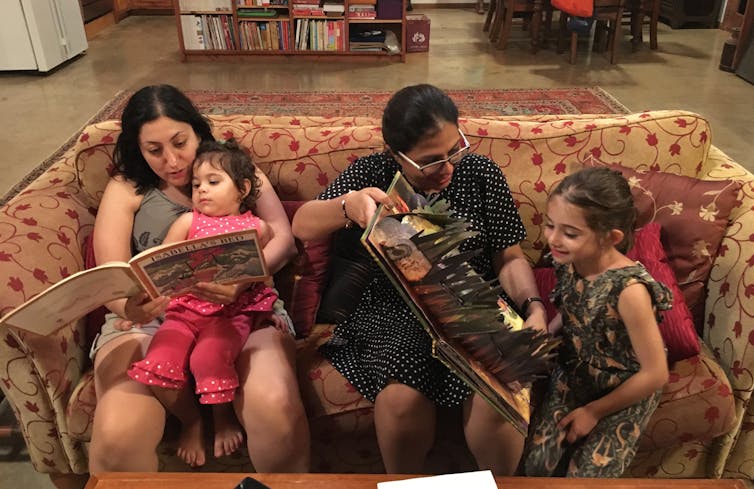
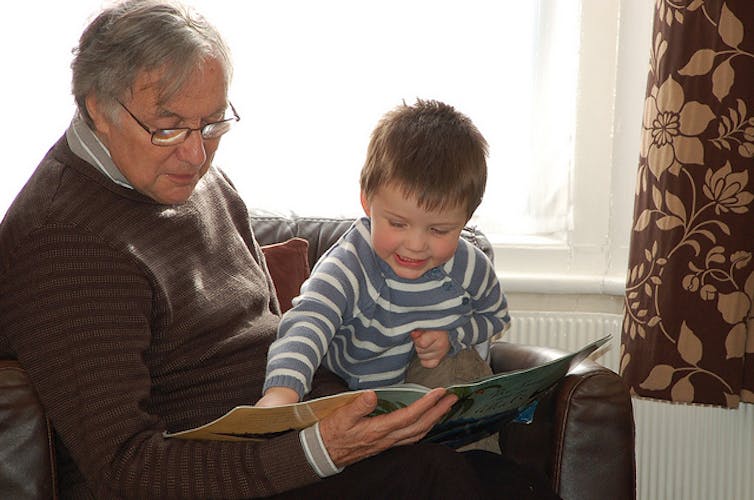
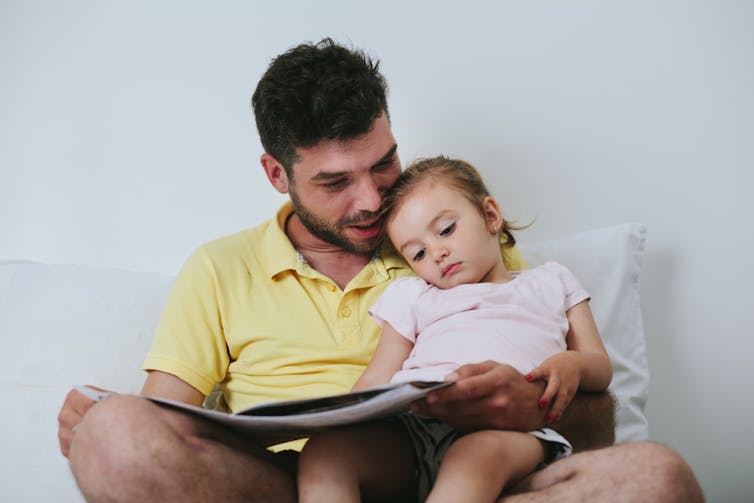
Reading to children is beneficial in many ways. Books offer a unique opportunity for children to become familiar with new vocabularies; the type of words not often used in day-to-day conversation. Books also provide a context for developing knowledge of abstract ideas for children. When an adult reads a book to a child, they often label pictures, talk about activities in the book, solve problems together and teach them new words and concepts.
Reading to very young children can have long-lasting benefits for their later school success, not only in literacy but also in mathematics. Adding to this, early shared reading particularly helps children from disadvantaged families defy limitations associated with their socio-economic status. So, if there is only one thing you have time to do with your children, it should be reading to and with them.
Parents have long been encouraged to read more to their children. There have been many initiatives, challenges, and programs aiming to increase individual reading time and shared reading time between parents and children. These include the Australian Reading Hour Campaign, the Premier’s Reading Challenge, Let’s Read, and others.
Read more:
Five tips to help you make the most of reading to your children
What’s still not clear is which specific skills improve while parents read to their children, and whether the benefit of shared reading is due to other things parents do that help their children thrive at school and beyond.
That is: is it really book reading that’s beneficial or is it because parents who read more to their children also provide a lot of other resources, and engage in a range of other activities with their children?
This was what we looked at in our study. We used data from a large scale nationwide study called the Longitudinal Study of Australian Children (LSAC). It has followed the development of 10,000 children and their families since 2004.
The sample we studied consists of 4,768 children from the cohort that was zero to one year old when the study commenced. During face-to-face interviews with trained LSAC interviewers, parents reported the frequency of them reading to their children at the age of two every week.
The LSAC then followed these children until they were four and eight years old. The good news is the majority of parents reported reading to their children at least three days a week. Specifically, 61.6% of the parents reported reading to their children every day and 21.1% of the parents read to their children between three to five days a week.
Read more:
Enjoyment of reading, not mechanics of reading, can improve literacy for boys
Our study showed the benefits of shared reading with children during early childhood at two to three years old is long-lasting. The more frequently parents read to their children when they were two years old, the more likely their children had better knowledge of spoken words and early academic skills such as recognising and copying geometric shapes, and writing letters, words and numbers, two years later when children were four to five years old.
What’s more, frequent early shared reading was linked to better performance in NAPLAN reading, writing, spelling and grammar. More surprisingly it was also linked to mathematics even six years later when children were eight to nine years old in year three.
The most encouraging finding is that children from disadvantaged families benefited more from shared book reading. This suggests increasing the frequency of book reading is a viable way for disadvantaged families to support their children’s vocabulary knowledge and general academic achievement.
To address whether the benefits of shared reading are a product of other factors associated with parents and families, we controlled for the effect of a range of potential confounding factors. These include indicators of children’s intelligence, the number of children’s books at home, and home activities that parents engage with children other than reading. These would include drawing pictures or doing art activities with children, playing music together, playing with toys or games, and exercising together.
Even though we controlled for these other factors, the long-term importance of early shared reading still holds.
Read more to your children and with your children. Whenever you get a chance, even if it’s only ten minutes, engage in shared reading activities.
Read more:
Research shows the importance of parents reading with children – even after children can read
We also suggest parents make a reading session interactive. For example, parents are encouraged to ask children questions, such as if they know the vocabulary and ask them to guess the story and what the story characters will do. Try to make the reading a learning session.
 Finally, not all books are created equal. Parents are encouraged to choose the most suitable books for their child’s age to reap the most benefits of early shared reading.
Ameneh Shahaeian, Research Fellow in Developmental and Educational Psychology, Australian Catholic University and Cen Wang, Research Fellow in Educational and Developmental Psychology, Charles Sturt University
This article was originally published on The Conversation. Read the original article.
The link below is to an article (Blog post) that takes a look at the audiobook vs reading debate.
For more visit:
https://www.offthebeatenshelf.com/blog/ableist-authors
 At the BookShelf
You must be logged in to post a comment.