
Unknown's avatar

Once upon a time: a brief history of children’s literature


Image 20170328 21261 1t2c91q
Children’s books were historically moralising and instructive. What’s changed?
Hillarie/Flickr

Susan Broomhall, University of Western Australia; Joanne McEwan, University of Western Australia, and Stephanie Tarbin, University of Western Australia

April 2 is International Children’s Book Day and the anniversary of the birth of one of the most famous contributors to this genre, Hans Christian Andersen. But when Andersen wrote his works, the genre of children’s literature was not an established field as we recognise today. The Conversation

Adults have been writing for children (a broad definition of what we might call children’s literature) in many forms for centuries. Little of it looks much fun to us now. Works aimed at children were primarily concerned with their moral and spiritual progress. Medieval children were taught to read on parchment-covered wooden tablets containing the alphabet and a basic prayer, usually the Pater Noster. Later versions are known as “hornbooks”, because they were covered by a protective sheet of transparent horn.

A 1630 horn book.
Folger Digital Image 3304., CC BY-SA

Spiritually-improving books aimed specifically at children were published in the 17th century. The Puritan minister John Cotton wrote a catechism for children, titled Milk for Babes in 1646 (republished in New England as Spiritual Milk for Boston Babes in 1656). It contained 64 questions and answers relating to religious doctrine, beliefs, morals and manners. James Janeway (also a Puritan minister) collected stories of the virtuous lives and deaths of pious children in A Token for Children (1671), and told parents, nurses and teachers to let their charges read the work “over a hundred times.”

These stories of children on their deathbeds may not hold much appeal for modern readers, but they were important tales about how to achieve salvation and put children in the leading role. Medieval legends about young Christian martyrs, like St Catherine and St Pelagius, did the same.

Other works were about manners and laid out how children should behave. Desiderius Erasmus famously produced a book of etiquette in Latin, On Civility in Children (1530), which gave much useful advice, including “don’t wipe your nose on your sleeve” and “To fidget around in your seat, and to settle first on one buttock and then the next, gives the impression that you are repeatedly farting, or trying to fart. So make sure your body remains upright and evenly balanced.” This advice shows how physical comportment was seen to reflect moral virtue.

Erasmus’s work was translated into English (by Robert Whittington in 1532) as A lytyll booke of good manners for children, where it joined a body of conduct literature aimed at wealthy adolescents.

In a society where reading aloud was common practice, children were also likely to have been among the audiences who listened to romances and secular poetry. Some medieval manuscripts, such as Bodleian Library Ashmole 61, included courtesy poems explicitly directed at “children yong”, alongside popular Middle English romances, saints’ lives and legends, and short moral and comic tales.

Do children have a history?

A lot of scholarly ink has been spilled in the debate over whether children in the past were understood to have distinct needs. Medievalist Philippe Ariès suggested in Centuries of Childhood that children were regarded as miniature adults because they were dressed to look like little adults and because their routines and learning were geared towards training them for their future roles.

But there is plenty of evidence that children’s social and emotional (as well as spiritual) development were the subject of adult attention in times past. The regulations of late medieval and early modern schools, for example, certainly indicate that children were understood to need time for play and imagination.

Pieter Bruegel the Elder, Children’s Games, 1560.
Wikimedia Commons

Archaeologists working on the sites of schools in The Netherlands have uncovered evidence of children’s games that they played without input from adults and without trying to emulate adult behaviour. Some writers on education suggested that learning needed to appeal to children. This “progressive” view of children’s development is often attributed to John Locke but it has a longer history if we look at theories about education from the 16th century and earlier.

Some of the most imaginative genres that we now associate with children did not start off that way. In Paris in the 1690s, the salon of Marie-Catherine Le Jumel de Barneville, Baroness d’Aulnoy, brought together intellectuals and members of the nobility.

There, d’Aulnoy told “fairy tales”, which were satires about the royal court of France with a fair bit of commentary on the way society worked (or didn’t) for women at the time. These short stories blended folklore, current events, popular plays, contemporary novels and time-honoured tales of romance.

These were a way to present subversive ideas, but the claim that they were fiction protected their authors. A series of 19th-century novels that we now associate with children were also pointed commentaries about contemporary political and intellectual issues. One of the better known examples is Reverend Charles Kingsley’s The Water Babies: A Fairy Tale for a Land Baby (1863), a satire against child labour and a critique of contemporary science.

The moral of the story

By the 18th century, children’s literature had become a commercially-viable aspect of London printing. The market was fuelled especially by London publisher John Newbery, the “father” of children’s literature. As literacy rates improved, there was continued demand for instructional works. It also became easier to print pictures that would attract young readers.
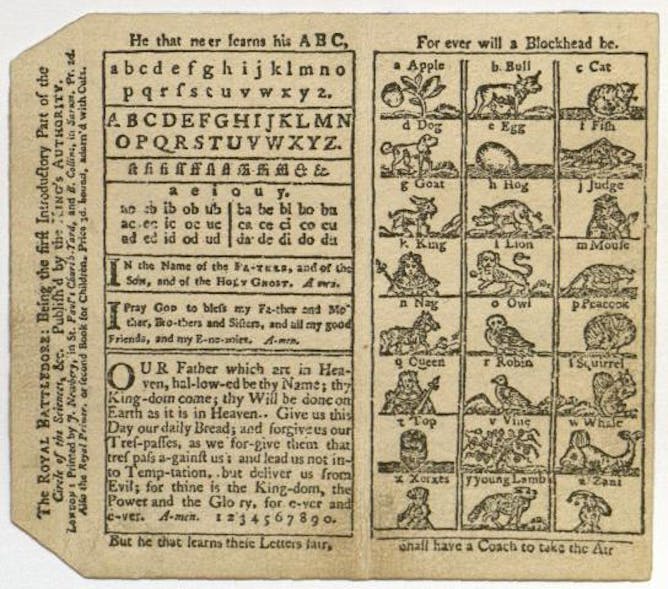
18th century Battledore printed by Newbery which adds pictures and a verse on the rewards of industry to the elements of the hornbook.

More and more texts for children were printed in the 19th century, and moralistic elements remained a strong focus. Katy’s development in patience and neatness in the “School of Pain” is key, for example, in Susan Coolidge’s enormously popular What Katy Did (1872), and feisty, outspoken Judy (spoiler alert!) is killed off in Ethel Turner’s Seven Little Australians (1894). Some authors managed to bridge the comic with important life lessons. Heinrich Hoffman’s memorable 1845 classic Struwwelpeter reads now like a kids’ version of dumb ways to die.
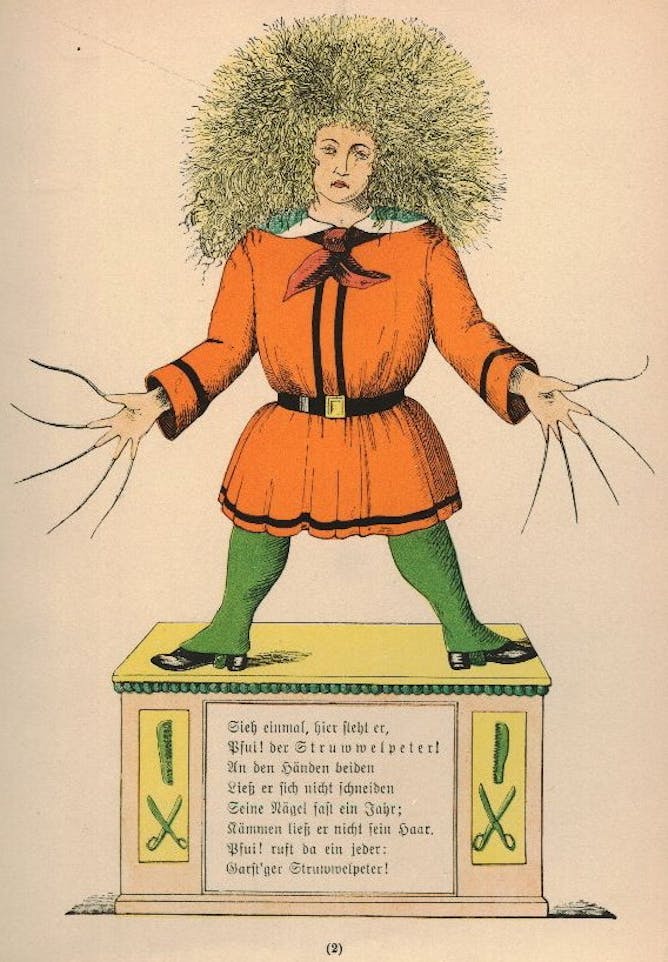
Struwwelpeter (‘Shock-headed Peter’) in a 1917 edition.
Wikimedia commons

By the turn of the 20th century, we see the emergence of a “kids’ first” literature, where children take on serious matters with (or often without) the help of adults and often within a fantasy context. The works of Lewis Carroll, Robert Louis Stevenson, Mark Twain, Francis Hodgson Burnett, Edith Nesbit, JM Barrie, Frank L Baum, Astrid Lindgren, Enid Blyton, CS Lewis, Roald Dahl and JK Rowling operate in this vein.

Children’s books still contain moral lessons – they continue to acculturate the next generation to society’s beliefs and values. That’s not to say that we want our children to be wizards, but we do want them to be brave, to stand up for each other and to develop a particular set of values.

We tend to see children’s literature as providing imaginative spaces for children, but are often short-sighted about the long and didactic history of the genre. And as historians, we continue to seek out more about the autonomy and agency of pre-modern children in order to understand how they might also have found spaces in which to exercise their imagination beyond books that taught them how to pray.

Susan Broomhall, Director, Centre for Medieval and Early Modern Studies, University of Western Australia; Joanne McEwan, Researcher, University of Western Australia, and Stephanie Tarbin, Lecturer in medieval and early modern history, University of Western Australia

This article was originally published on The Conversation. Read the original article.

Unknown's avatar

Children prefer to read books on paper rather than screens


Image 20170308 27373 1q6ikjl
Children may actually prefer reading books the traditional way.
from http://www.shutterstock.com

Margaret Kristin Merga, Murdoch University and Saiyidi Mat Roni, Edith Cowan University

There is a common perception that children are more likely to read if it is on a device such as an iPad or Kindles. But new research shows that this is not necessarily the case. The Conversation

In a study of children in Year 4 and 6, those who had regular access to devices with eReading capability (such as Kindles, iPads and mobile phones) did not tend to use their devices for reading – and this was the case even when they were daily book readers.

Research also found that the more devices a child had access to, the less they read in general.

It suggests that providing children with eReading devices can actually inhibit their reading, and that paper books are often still preferred by young people.

These findings match previous research which looked at how teenagers prefer to read. This research found that while some students enjoyed reading books on devices, the majority of students with access to these technologies did not use them regularly for this purpose. Importantly, the most avid book readers did not frequently read books on screens.

Why do we think children prefer to read on screens?

There is a popular assumption that young people prefer to read on screens. This was mainly driven by education writer Marc Prensky who in 2001 coined the term “digital natives”. This term characterises young people as having high digital literacy and a uniform preference for screen-based reading.

But young people do not have a uniform set of skills, and the contention that screens are preferred is not backed up by research.

Despite this, the myth has already had an impact on book resourcing decisions at school and public libraries, both in Australia and in the US, with some libraries choosing to remove all paper books in response to a perceived greater preference for eBooks.

But by doing this, libraries are actually limiting young people’s access to their preferred reading mode, which in turn could have a detrimental impact on how often they choose to read.

Young people are gaining increasing access to devices through school-promoted programs, and parents face aggressive marketing to stay abreast of educational technologies at home.

Schools are motivated to increase device use, with Information and Communication Technology being marked as a general capability to be demonstrated across every subject area in the Australian Curriculum.

The drivers toward screen-based recreational book reading are strong, but they are not well-founded.

Why are students more likely to prefer paper books?

Reading on devices through an application leaves more room to be distracted, allowing the user to switch between applications.

For students who already experience difficulty with attention, the immediate rewards of playing a game may easily outweigh the potentially longer-term benefits of reading.

Digital literacy could also be an issue. In order to use a device to read books, children need to know how to use their devices for the purpose of reading books.

They need to know how to access free reading material legally through applications such as Overdrive or websites such as Project Gutenburg.

Tips for encouraging your child to read

Research shows that reading books is a more effective way to both improve and retain literacy skills, as opposed to simply reading other types of text. Yet international research suggests that young people are reading fewer and fewer books.

While equipping children with devices that have eReading capability is unlikely to encourage them to read, there are a number of strategies, supported by research, that can help encourage children to pick up a book. These include:

  • Be seen to enjoy reading. This study found that a number of students did not know if their literacy teachers actually liked reading. Teachers who were keen readers inspired some students to read more often and take an interest in a broader range of books.

  • Create (and regularly access) reading-friendly spaces at home and at school. Loud noises, poor lighting and numerous distractions will not help provide an enjoyable reading experience, and are likely to lead to frustration.

  • Encourage regular silent reading of books at school and at home. Giving children time to read at school not only encourages a routine of reading, but it also may be the only opportunity a child has to read self-selected books for pleasure.

  • Teachers and parents should talk about books, sharing ideas and recommendations.

  • Continue to encourage your child and students to read for pleasure. While we know that children tend to become disengaged with books over time, in some cases this can be due to withdrawal of encouragement once children can read on their own. This leads children to falsely assume that reading is no longer important for them. Yet reading remains important for both children an adults to build and retain literacy skills.

  • Find out what your child enjoys reading, and support their access to books at school and at home.

Margaret Kristin Merga, Lecturer and Researcher in Adolescent Literacy, Health Promotion and Education, Murdoch University and Saiyidi Mat Roni, Lecturer, Edith Cowan University

This article was originally published on The Conversation. Read the original article.

Unknown's avatar

Why children’s books that teach diversity are more important than ever


BJ Epstein, University of East Anglia

If you think back to your childhood, what sticks with you? For many people, it’s those cosy times when they were cuddled up with a parent or grandparent, being read a story.

But bedtime stories aren’t just lovely endings to the day or a way to induce sleep, they are also a safe way to experience and discuss all sorts of feelings and situations. So even when children think they’re just being told about an adorable bunny’s adventures, they are actually learning about the world around them.

We know that children’s books can act like both mirrors and windows on the world. Mirrors in that they can reflect on children’s own lives, and windows in that they can give children a chance to learn about someone else’s life. We also know that this type of self-reflection and opportunity to read or hear about different lives is essential for young people.

Research on prejudice shows that coming in contact with people who are different – so-called “others” – helps to reduce stereotypes. This is because when we see people who initially seem different, we learn about them and get closer to them through their story. The “other” seems less far away and, well, less “otherly”.

But while it may be ideal for children to actually meet people from different backgrounds in person, if that isn’t possible, books can serve as a first introduction to an outside world.

Representing the world

Despite knowing how important it is for diversity to be represented in our day-to-day lives, many children’s books are still littered with white, male, able-bodied, heterosexual, cisgender, nominally Christian characters. And research suggests that over 80% of characters in children’s books are white – which clearly doesn’t reflect the reality of our world.

All of these reasons are why the We Need Diverse Books movement was set in motion in 2014, stemming from a discussion between children’s books authors Ellen Oh and Malinda Lo. The movement aims for more diverse children’s books to actually be created and for these works to be available to young people. And while we need people to actually write them, we also need publishers to produce them, and bookstores, libraries, and schools to stock them.

Getting diverse books into the hands of young readers.
Pexels.

As someone who researches children’s literature, I think we’d have fewer conflicts in the world if we all read more diverse literature and lived more diverse lives.

I like to think that if we had more diverse children’s books, featuring a broad range of characters in many different jobs and situations, as well as more diverse role models in the media, young people would feel empowered, and they’d believe that when they grow up, they could be anyone and do anything they wanted. And they’d look at their friends and think the same for them, and they’d grow up respecting and appreciating everyone’s talents.

With this mindset present, issues such as race or religion wouldn’t even play a subconscious role. And it would mean that within a generation or two, we wouldn’t read articles about appalling and depressing statistics, and we wouldn’t need campaigns to increase diversity in literature, academia, or anywhere else.

Role models

But books aren’t just about “others”. When we see people like ourselves in the media, including in fiction, we get a glimpse of who we might become, and we feel validated. We can gain role models and inspiration through literature.

Perhaps partly in response to people’s growing awareness of the need for role models – whether in person or in literature – one young black girl, Marley Dias, started a campaign to find 1,000 “black girl books”. Dias recommends works such as Brown Girl Dreaming by Jacqueline Woodson, One Crazy Summer by Rita Williams-Garcia, Chains by Laurie Halse Anderson and I Love My Hair by Natasha Anastasia Tarpley.

But I wonder how many of those “black girl books” feature black girls in prominent roles, such as working as professors, doctors, teachers, or even as presidents of nations. I have a suspicion that the percentage would be disappointingly low.

Wanted: diverse role models.
Shutterstock

Just featuring a minority character isn’t enough to create quality diverse literature, but it is a first step. And while there are some useful websites that recommend diverse children’s books and even literary awards dedicated to promoting such works, much still needs to be done.

Along with the increased worries today about immigrants, refugees, and general “otherness”, some societies seem to be headed towards a sense of false nostalgia about a time when the world was controlled by whites.

Given this is not how the world is or should be, we owe it to young readers to show them reality in the books they’re reading. Perhaps then the next generation will be less frightened of the “other” if they get to meet them and learn about them from an early age.

The Conversation

BJ Epstein, Senior Lecturer in Literature and Public Engagement, University of East Anglia

This article was originally published on The Conversation. Read the original article.

Unknown's avatar

Summer reading list: ten best children’s books of 2016


Belle Alderman, University of Canberra

It’s not always easy to keep kids reading over the summer holidays. But research shows that those who stop reading over these long breaks from school are actually at risk of seeing their reading ability drop during this period. This is called the “summer slide”.

But there are simple ways to prevent this from happening. Reading just four or five books over the summer can stop the slide.

Reading regularly also helps to develop a child’s language and comprehension, enhance listening and speaking skills, and help with the understanding of narrative and story. Reading to your child during pre-school years has even been shown to boost their literacy levels.

Children are, unsurprisingly, more likely to read when they find a story interesting and engaging. With this in mind, I’ve pulled together a list of great new books that have been published this year that are sure to keep kids engaged in reading over the summer break.


Harper Collins Publishing

1. Hello Little Babies by Alison Lester

(Harper Collins Publishers, 2016) Ages: 0 – 3 years

Cameos of babies’ lives and their families feature in ordinary but universal scenes starring babies as they sleep, play, eat and explore life.

The short, familiar text, such as “Zane rubs corn in his hair” and “Vikram yawns and stretches”, is perfect for parents to read aloud. Lester is at her finest in capturing the minutia of the ordinary and rendering it memorable.

Further reading: Lester’s 48-page colouring-in book, Wonderful World, featuring characters and scenes from her books Imagine, Magic Beach and others, is the perfect companion.

Parents might collect Lester’s books and join in a game of “find the characters” appearing in the colouring book.


Penguin Books Australia

2. Who sank the boat? And other stories by Pamela Allen

(Penguin, 2016) Ages: 1 – 5 yrs

Here’s a treasure trove of nine familiar favourites by a creator who excels in the art of simplicity, humour, playful images and universally loved stories including Grandpa and Thomas and Belinda. Allen’s jaunty language is perfect for reciting and performance by pre-schoolers.

Parents will enjoy performing words and actions and talking about the subtle character-building ideas, such as being kind to others and working together.


Little Brown

3. One Minute Till Bedtime written by Kenn Nesbitt, illustrations by Christoph Niemann

(Little Brown, 2016) Ages: 3 and up

These 60-second poems are perfect bedtime reading. Five countries, including Australia, feature in these 132 selections, each evoking strong emotions. Included are abecedarian, pantonums and haiku poems, plus others. The illustrations are minimalist and clever, ensuring imaginations are engaged.

Australia’s poems by Kathryn Apel, Mark Carthew, Sophie Masson and others add to the international flavour. Parents prepare for a rollicking read aloud and discussion of other kinds of poetry than those here.


Black Dog Books

4. Welcome to Country written by Aunty Joy Murphy, illustrated by Lisa Kennedy

(Black Dog Books, 2016) Ages: 5 and up

Welcome to country ceremonies are an important part of major events. They signify cultural greetings by Aboriginal elders who grant permission for visitors to enter their traditional lands.

This stunningly illustrated book has a deep yet simple text, which introduces its central concept through poetic language and earthy, evocative landscapes of blended colours and shapes of people and landscapes.

“We are part of the land and the land is part of us” reminds us to respectfully share cultural traditions. Parents might collect a range of picture books by Aboriginal creators for children, comparing illustration styles and discussing the meaning underlying traditional stories.


Allen & Urwin

5. The Sisters Saint-Claire written by Carlie Gibson, illustrated by Tamsin Ainslie

(Crows Nest, NSW : Allen & Unwin, 2016) Ages: 7 and up

Gibson’s debut, gem-like story offers likeable characters, a tasty dilemma and a satisfying ending. Appealing ingredients include a family of four French mice who adore food, family and fashion, intricately detailed illustrations, lavish banquets of French food and a text in delectable rhythm and rhyme.

Adults and child can explore places in the world, locate these on maps, and share cultural diversity.

Further reading: Similar in whimsical detail, but featuring enchanting rabbit characters, is the trio of books by Kate Knapp about Ruby Red Shoes. Ruby’s adventures to distant places are told in entrancing prose and feature detailed, whimsical illustrations.


National Library of Australia Publishing

6. Amazing Animals of Australia’s National Parks by Gina M Newton

(National Library of Australia, 2016) Ages: 8 and up

Australia is home to over 110,000 species of animals and here in Newton’s large, lavishly designed book are 120 – most existing only in Australia. The beautifully designed layout conveys information so jam-packed that readers will return again and again.

Basic and iconic information include slang, sports, places to visit, and lots of food. Adults reading this book (and the one below) with children might want to talk about the importance of looking after the environment.

Further reading: Tania McCartney’s book, Australia illustrated, in a similar large and inviting format, offers fascinating titbits about all Australian states and territories.


Allen & Urwin

7. Artie and the Grime Wave by Richard Roxburgh

(Allen & Urwin, 2016) Ages: 8 and up

Artie and his best friend Bumshoe discover a cave-of-possibly-stolen-stuff, then match wits and defeat our shady characters including fang-toothed Funnel-web and the dastardly Mayor Grime.

High-appeal ingredients abound in this mystery-adventure: a struggling underdog; good-hearted friends; moments of bravery; slightly dangerous baddies and a rip-roaring pace. The quirky line illustrations perfectly capture inventions like the “super snotter” and shady characters in zany, slightly dark, line illustrations.

Parents might compare this work with other popular humorous authors and illustrators such as Andy Griffiths and Terry Denton with their Magic Tree House series.


National Library of Australia

8. Radio Rescue written by Jane Jolly, illustrated by Robert Ingpen

(National Library of Australia, 2016) Age: 9 and up

Two masters of story and illustration combine their art to reveal a fascinating piece of Australian history — how “the world burst open” with the invention of the pedal radio. The facts are astonishing, but the human story adds great appeal.

Young Jim and his mum and dad love station life but long for human contact, and worry about disaster striking. Jane Jolley’s text is simple with appealing repetition perfect for reading aloud.

Robert Ingpen’s signature soft pencil sketches and luminous foldouts are unforgettable. Parents might find other books about significant inventions and innovations in our world such as transportation and the Internet, and talk how these have changed our lives.


Allen & Urwin

9. Tales from Outer Suburbia by Shaun Tan

(Allen & Urwin, 2016) Ages: 10 and up

Shaun Tan’s 15 short stories explore unique, perplexing and sophisticated ideas with unforgettable images. One story centres on Eric, tiny in size but large in heart. He leaves behind an unforgettable gift for his human friends. Another story features satirically decorated missiles in front yards. Tan puts a twist in this tale, prodding the reader to think. A family with little money creates a richly imaginative attic retreat.

Parents will enjoy reading Tan’s crisp proud aloud and luxuriate in his mesmerising illustrations, then discussing the many layers of his work. Then, as a family, put together the accompanying Shaun Tan 750-piece puzzle.


Hachette Australia

10. The Bone Sparrow by Zana Fraillon

(NSW : Hachette, 2016) Ages: 12 and up

Occasionally a book leaves an indelible impression, irrevocably changing one’s worldview. This is one of those books.

Ten-year-old Subhi is a refugee, born in a permanent Australian detention centre. Though he knows no other life, his imagination soars and offers comfort. When he meets a young girl from the other side of the fence, their lives change forever.
Family members loved and lost weave throughout this story. The prose is lyrical, and there are light moments. Read this book as a family and explore injustices, hope and love.

Further reading

You might also like “A love and feel for place : Australian illustrated children’s books – in pictures” by Leigh Hobbs.

All the books listed were published in 2016 and reflect Australia’s rich and diverse creative talent.

The Conversation

Belle Alderman, Emeritus professor of children’s literature, University of Canberra

This article was originally published on The Conversation. Read the original article.

Unknown's avatar

Reading with your children: proper books vs tablets


Nicola Yuill, University of Sussex

Most of us have an opinion about whether we prefer reading on screen or paper: but what difference does it make for children? The truth is that technology is now encountered from babyhood. Anecdotes abound of toddlers swiping their fingers across paper rather than turning the page, while parents and teachers express their fear of screen addiction as tablets introduce new distractions as well as new attractions for young readers.

Ofcom figures tell us that children’s screen use rises sharply towards the end of primary school (from age seven to 11) and in the same period, book-reading drops. Increasing screen use is a reality, but does it contribute to a loss of interest in reading, and does reading from a screen provide the same experience as the feel of reading on paper?

We looked at this in our research on shared reading. This has been a neglected topic even though it is clearly a common context for children when they read at home. It might be their regular homework reading of a book from school, or a parent reading them a favourite bedtime story.

Warming up

We asked 24 mothers and their seven to nine-year-old children to take turns – mother reading or child reading – with popular fiction books on paper, and on a tablet. They read Barry Loser: I am not a Loser by Jim Smith and You’re a Bad Man, Mr Gum by Andy Stanton. We found that the children’s memory for the descriptions and narratives showed no difference between the two media. But that’s not the whole story.

The interactions of parent and child were found to be different in the independent ratings from video observation of the study. When they read from paper rather than a screen, there was a significant increase in the warmth of the parent/child interactions: more laughter, more smiling, more shows of affection.

It may be that this is largely down to the simple physical positioning of the parent and child when using the different media, as well as their cultural meaning. When children were reading from a screen, they tended to hold the tablet in a head-down position, typical of the way they would use the device for solo activities such as one-player games or web-browsing.

This meant that the parents had to “shoulder-surf” in order to share visual attention. In contrast, when parents read to their children on paper, they often held the book out to support shared visual engagement, tucking the child cosily under their arms. Some children just listened without trying to see the book, but instead curled themselves up comfortably on the sofa.

Paper or pixels?
Megan Trace/Flickr, CC BY-NC

Keep taking the tablets?

Our research joins a growing list of studies comparing paper and e-books, but the answer isn’t a simple one. Shared reading is different to reading alone, for a start. And we may be interested in whether screen or paper makes a difference in how children learn to read, to understand, and enjoy reading. In short there are multiple perspectives to consider – developmental, educational, literary and technological – if we are to decide which medium is preferable.

Most studies have compared children at the earliest stages of reading, using paper books, e-books with audio and dictionary support to help less-skilled readers, and so-called “enhanced” e-books with multimedia, activities, hotspots and games.

Text with audio support helps children to decode text, and multimedia can keep a reluctant reader engaged for longer, so a good e-book can indeed be as good as an adult reading a paper book with their child. But we don’t yet have long-term studies to tell us whether constant provision of audio might prevent children developing ways of unpicking the code of written language themselves.

They think I’m reading; I’m playing Candy Crush.
George Rudy/Shutterstock

Re-design for life

There is also increasing evidence that adding multimedia and games can quickly get distracting: one study found that young children spent almost half their time playing games in enhanced e-books, and therefore they read, remembered and understood little of the story itself. But there is plenty of guidance for e-book developers on the what, where and how much of designing multimedia texts.

And that brings us back to perhaps the defining conclusion from our own study. Books versus screens is not a simple either/or – children don’t read books in a cultural vacuum and we can’t approach the topic just from a single academic field. Books are just books, with a single typical use, but screens have many uses, and currently most of these uses are designed round a single user, even if that user is interacting with others remotely.

We believe that designers could think more about how such technology can be designed for sharing, and this is especially true for reading, which starts, and ideally continues, as a shared activity in the context of close long-term family relationships. Book Trust figures report a drop from 86% of parents reading with their five-year-olds to just 38% with 11-year olds. There is a possibility that the clever redesign of e-books and tablets might just slow that trend.

The Conversation

Nicola Yuill, Senior Lecturer in Psychology, University of Sussex

This article was originally published on The Conversation. Read the original article.

Unknown's avatar

How Australia’s children’s authors create magic on a page


Elizabeth Hale, University of New England

For a prime example of Australia’s innovation economy in action, look no further than the humble picture book. Staple of bedtime reading, offering textual delights beyond the verbal, picture books are a hidden treasure.

Australian picture books sell around the world, and are translated into many languages — take for instance, Jackie French’s iconic Diary of a Wombat (2002), which appears in French, German, Korean, and many more. But though the words need translating, the images, (in French’s book by Bruce Whatley), communicate across language barriers.

The interplay between words and images is one of the magic ingredients in a show-stopping picture book. Achieving that magic requires serious innovation. Writers, illustrators and editors work hard to balance word with image, and to carry the story or message through both.

It takes time, dedication, and care to make a picture book, and though some may be flipped through in minutes, others repay repeated reading and looking. Next time you pick one up in a bookshop or library, look at its design, the way the pictures engage with character, or setting, or contribute to mood, theme, and the controlling idea.

Dirty Dinsoaur by Janeen Brian
Viking

Ann James’s illustration of I’m a Dirty Dinosaur (2013) (text Janeen Brian) is a recent example. James’s lively dinosaur invites children in to the story, acting out the rhymes:

I’m a dirty dinosaur
with a dirty snout.
I never wipe it clean
I just sniff and snuff about.

Simple but evocative line drawings of this muddy dinosaur (made using Victorian mud!) connect beautifully with the energy of the rhymes, and provide young readers with visually engaging and memorable ideas.

Kevin Burgemeestre’s wonderful handmade dioramas on the cover of the recent Hush Treasure Book (2015) show that illustrations don’t have to be drawn to be lively and vivid. Indeed, in another of his books, B is for Bravo (2003), they provide a realistic but imaginative romp through an excitingly three-dimensional alphabet of Australian Aviation.

Illustrators conduct specific research to find just the right images for particular stories. Anne Spudvilas’s illustrations for the picture book version of Li Cunxin’s Mao’s Last Dancer (2003) use traditional watercolour, and collage from old newspapers, to convey the wealth and variety of Chinese culture.

Experimentation, consultation, imagination, teamwork and individual interpretation are the name of the game. And they demonstrate the incredible care writers and illustrators take to make books that speak to the text, and to the reader. You can see Ann James talk here about how she conveys emotion in collaboration with the author:

Jeannie Baker, meanwhile, takes collage to its highest level in her carefully crafted books. Her Window (1991), and Where the Forest Meets the Sea (1987) use layered and detailed images and to convey a powerful environmental message.

Sometimes words are unnecessary. Shaun Tan’s The Arrival (2007) tells a moving story about immigration through sepia pictures arranged as if in an old photo album. Any words would break the spell cast by these pictures, which call for a slow and thoughtful reading. Indeed, the only words that appear in the book are in a made-up font. Their unrecognisability symbolises the challenges facing new immigrants who have yet to learn the local language.

Gregory Rogers’s comic wordless story The Boy, the Bear, the Baron, the Bard (2004) is a wonderful contrast. Full of pace, fun, and historical detail, in company with the boy, bear and baron of the title, it takes us through the streets and theatres of Elizabethan London, pursued by the bard.

The Arrival by Shaun Tan
Hodder & Stoughton

And Nick Bland challenges the form of the picture book altogether, with The Wrong Book (2009), in which monsters, pirates, royalty and animals intrude on the protagonist’s attempts to tell a story. (It’s available as a lovely app)

Exact statistics as to the number of Australian illustrators are hard to come by: like authors, they receive royalties of up to 10% (sharing this figure, in the case of co-creation). And so, like so many creatives, to survive and flourish they have to be extremely energetic, professional and passionate about their work. To survive, they have had to innovate. Publishing opportunities are increasingly competitive, as the digital economy hits traditional publishers, though the development of the app-book offers new and interesting opportunities.

Many illustrators give classes, workshops, do school visits, are part of exhibitions, and support literacy initiatives at home and abroad. They find new ways to promote their work, and cross-fertilise with other industries.

I’ve only touched on a few of the many wonderful Australian creators of picture books for young (and not so young) readers. Next time you read one (to yourself or to others), you could think about the innovation economy that is the illustration industry. But hopefully, and more likely, you could settle back and enjoy the story – words, images, and all.


This week is Children’s Book Week. And the Children’s Book Council of Australia will announce a swag of prizes in various award categories, including picture books.

The University of New England has hosted many illustrators over the years through a Copyright Agency Cultural Fund supported residency program. The work they did is on display at the University Library.

The Conversation

Elizabeth Hale, Senior Lecturer in English and Writing (children’s literature), University of New England

This article was originally published on The Conversation. Read the original article.

Unknown's avatar

Friday essay: Feminist Medusas and outback Minotaurs – why myth is big in children’s books


Elizabeth Hale, University of New England

Gorgon: a vicious female monster with sharp fangs. Her power was so strong that anyone attempting to look upon her would be turned to stone. The Gorgon wore a belt of serpents that intertwined as a clasp, confronting each other. There were three Gorgons, and each one had hair made of living snakes.

In The Gorgon in the Gully (2010), Melina Marchetta’s delightful book for 10-12 year olds, no one has ever seen a Gorgon. But one apparently lives in a small valley near the sports fields at the school attended by a boy called Danny. When Danny looks up Gorgon on the internet, he finds the above definition. And his local Gorgon’s reputation for fierceness is only equalled by its record as a hoarder of balls.

So when Danny’s ball goes into the gully, and Simmo, the School Bully, dares him to go in after it, Danny is caught between his fear of the Gorgon, and his fear of being a “gutless wonder”.

His mother advises him to:

look at whatever you’re scared of from a different angle. Look at it up really close. Find a friend at school who’s not afraid to look at things up close with you.


Ŧhe ₵oincidental Ðandy

Which is what Danny does. Gradually, he becomes friends with Simmo, and they work together to confront the Gorgon. When they finally do, they discover it is nothing like their imaginings. Indeed it’s not a Gorgon at all. It is a gentle old man who has been wondering when the children are going to retrieve their balls. In conquering his fear, Danny conquers the Gorgon, gets his ball back and becomes known as “Gorgon-buster”.

The Gorgon in the Gully goes neatly to the core of the Medusa allegory: if fear is petrifying, one needs to know how to look at it “up close”.
And like the hero Perseus assisted by the goddess Athena, who used a reflective shield to deflect Medusa’s stare and avoid being petrified, Danny finds a way to look closely at his fears from different angles, and to overcome them.

Lurking in literature

Monsters from classical myth have been lurking in the gullies of Western literature for a long time – in retellings and adaptations, and acting as symbols and metaphors for aspects of the human experience.

They’ve been surfacing recently in fantasy for children and young adults. Imaginary Medusas, realistically drawn Minotaurs, as well as a multitude of many-headed Scyllas, Hydras and Cerberuses: they all appear in Australian children’s and YA fiction.

Why are so many contemporary writers reconnecting with the monsters of classical myth? I think it’s partly because they provide profound connections to issues of identity, coming of age, and finding one’s place in the world. These are fundamental matters in children’s literature, which aims to educate and socialise children to fit in, and also to express their concerns about the world and their place in it.

And writers are working now in a globalised context, with a rich cornucopia of referents. The mash-up culture of film, television, gaming and comic book franchises is a case in point, in which protagonists connect with figure after figure from myth and legend.

It’s fun to play with mythical beasts. And it’s interesting to connect to them as well.

https://c311ba9548948e593297-96809452408ef41d0e4fdd00d5a5d157.ssl.cf2.rackcdn.com/2016-06-03-mythical-beasts/loader.html

Mixing with Medusa

Connecting with Medusa can mean confronting her monstrous powers, facing the fear she represents. It can also mean sympathising with her.

As Ovid tells it, in one version of the myth (which like all classical myth has many variants), Medusa was seduced (or raped) by Poseidon in Athena’s temple, and Athena transformed her beautiful hair into snakes as a punishment for this defilement. Like many monstrous tales in Greek mythology, it doesn’t seem fair.


sookie, CC BY

Today, some Australian writers are more sympathetic to Medusa, as can be seen in The Gaze of the Gorgon (2002), by Karen R. Brooks. This is the second novel in a four-part portal fantasy in which a magic necklace takes 13 year old Cassandra Klein to Morphea, a mystical realm in which myths and fairytales are living and real. There, she does battle with the witch Hecate, who is trying to get control over this fantasy world, and who forces Medusa to use her powers to turn the Morpheans to stone.

But when Caz meets Medusa, she discovers that she is, in fact, an unwilling tool of Hecate. Together, they agree to “reverse the evil” that has been done, and give the petrified ones back their lives. This means that Caz has to kill Medusa.

Gazing at the bowed head of the Gorgon, Caz took a deep breath. ‘I am so sorry,’ she whispered. And before she could change her mind, raised the sword above her head and dropped her arms.

The Gaze of the Gorgon, by Karen Brooks.
Lothian Books (2002)

Caz and her friends gather the blood spurting from Medusa’s neck, and use it to heal wounds and revive the petrified. By willingly submitting to Caz’s blade, Medea’s death-dealing monstrosity is transformed into healing powers. It’s a revisionist take on the subject that comments on and compensates for the essential unfairness of Medusa’s treatment, both at the hands of Brooks’s Hecate, and Poseidon and Athena.

Mining hidden fears

This revisionist approach, which challenges the original myths, can also be seen in treatments of the Minotaur. To summarise the famously tangled myth: it is half-bull, half-man, the product of a union between Pasiphae, the queen of Crete, and a snow-white bull sent to the King (Minos) by Poseidon for sacrifice.

Because Minos kept the bull alive, Poseidon punished the family by making Pasiphae fall in love with it. And when she gave birth to the Minotaur, King Minos had it shut away in the Labyrinth, created by the master-inventor, Daedalus. Minos demanded regular sacrifice of Athenian youths and maidens – to be sent into the Labyrinth and devoured by the Minotaur.

The Athenian hero Theseus volunteered to go. Ariadne (daughter of Minos and Pasiphae) helped him find his way in and out of the labyrinth, using a ball of thread to guide him. He repaid her by abandoning her on an island, where she was discovered and taken up by Bacchus.

Theseus killing the Minotaur in Hyde Park’s Archibald Fountain.
Gord Webster, CC BY-SA

Jennifer Cook’s Ariadne: The Maiden and the Minotaur (2005) is set in ancient Greece, and tells this story from the point of view of a key player, the princess Ariadne, or Ari.

Ariadne: The Maiden and the Minotaur, by Jennifer Cook.
Lothian Books (2005)

Cook’s Ari is an impatient, irreverent, lively modern teenager, highly critical of her family.

Here, Cook draws attention to the point that the Minotaur is Ariadne’s blood relation, recasting it as Ari’s little brother “Tori”, a disabled child, Pasiphae’s illegitimate son (born from an affair, but not an affair with a bull). To his family, Tori is a symbol of shame and disgrace, both illegitimate and disabled.

In Cook’s story, it’s the Labyrinth, designed to contain many vicious traps, and King Minos’ insistence on the sacrifices, that kill the Athenians not the Minotaur.

In conspiring with Theseus, Ari saves Tori, and escapes with him. Far from being abandoned by Theseus and taken up by Bacchus she finds true love elsewhere, fading out of recorded story, with satisfaction.

When I asked Cook what drove this depiction of a feisty Ariadne, she replied:

I remember hearing the Minotaur myth and wondering about Ariadne and thinking how typical it was of the Greek hero Theseus to get all of the help from her and then take all of the credit. To add insult to injury he dumps her and takes off with her sister. And her reward? To get ‘married’ (Greek myth parlance for raped) by Dionysos [Bacchus]. And yes, I did my honours degree in feminist history.

Cook’s feminism, coupled with her sympathy for the Minotaur as unwitting victim of a dysfunctional family (and also of the gods), influences her approach to the myth. In essence it is a coming-of-age story, in which Ariadne identifies the true monsters in her family. Tori stands for all that the family is ashamed of; the myth of the Minotaur stands for the lies people tell when the truth is too frightening. In caring for Tori and rescuing him, Ari demonstrates modern Australian ideas of love, justice, and empathy far different from the stark ironies of the Ancient Greek myths.

Liberating and facing the Minotaur

These modern Australian attitudes can be seen too, in Myke Bartlett’s fantasy novel for teenagers, Fire in the Sea (2012), in which a terrifying Minotaur comes to Australia on a mystical mission to restore the lost city of Atlantis to life:

All eyes were on the matted fur of his head, the exposed and bloodied teeth, and the horns. The head of a bull, the body of a man, the teeth of a lion.

Fire in the Sea, by Myke Bartlett.
Text Publishing, 2012

In this story, fantasy elements intrude on the real world and have to be dealt with by the protagonist, a teenage orphan called Sadie. She faces a brutally bestial fighting machine in the Minotaur. Yet as the story unfolds, Sadie discovers the Minotaur is a slave to Atlantis’s head priestess, Lysandra, acting against its will to keep her in power.

In the novel’s end game, when Lysandra’s realm is disintegrating below the waves, Sadie confronts the Minotaur, believing she is ready to kill it. But she looks into its eyes, and sees flickers of humanity. Unable to slay the beast, she severs the chain around its neck, liberating it from servitude.

Here, Bartlett points to the tragedy of the Minotaur’s origins: as an unwitting byproduct of the gods’ and humans’ treachery, it is forced to act as a symbol of monstrosity.

The book also makes a point that life is worth the risk of death. As an orphan who has witnessed her parents’ death, Sadie is deeply afraid of dying. Letting the Minotaur go means risking that it will kill her: what she is most afraid of.

Worse things than death?

But perhaps there are worse things than death. And in Requiem for a Beast (2007), writer-illustrator-musician Matt Ottley uses the figure of the Minotaur to explore the pain of monstrous pasts, personal and national.

Requiem For A Beast, by Matt Ottley.
Hachette Australia (2007)

Requiem for a Beast is the story of a young stockman who confronts his own, his father’s and his country’s past. During a routine muster, he tracks down a magnificent bull that has evaded capture. He traps it in a ravine, where it falls and is badly wounded. Knowing that if he does not act, it will die a lingering death, the boy takes his knife and kills the bull.

Coming of age can mean confronting one’s demons, coming to terms with one’s past. And as the boy reflects on his encounter with the bull, his story is told through flashbacks: to his childhood, to learning of his father’s shameful story – he had been part of a group of men who had killed a young Aboriginal boy – and reflections about the Stolen Generation.

This book is shot through with iconic Australian imagery – the big sky, the harsh but beautiful landscape, the image of the drover and the muster. And linking them to the boy’s inner drama is the image of the Minotaur.

Otley anchors this specifically to a key memory from the boy’s childhood: visiting a museum with his father, they enter the mythology room, where the father explains the myth of the Minotaur.

What was it that happened that day? Why did that strange beast follow me – out of the museum and into the rest of my life? It hunted me, tracked me through the years, and slowly drew my spirit – who I was – from me until there was nothing left.

What indeed? What is Ottley’s Minotaur? A symbol of the repressed and repression? Of the violence of Australia’s past? A symbol of the demons teenagers face as they transition from childhood to adulthood, and come of age?

The book connects classical myth to the teenage experience, and also to the iconic myths and stories of Australian culture, while considering important national issues like the Stolen Generation. It runs the risk of imposing the standards of the Western canon onto the local context (as Erica Hately points out) yet it also shows the power of classical material to open up important discussions about our own culture.

A minotaur relaxes at Bondi beach.
Nicole Grech, photograph by Bentley Smith, CC BY-NC-SA

Myth in our DNA

I’ve focused here on Medusas and Minotaurs. But Australian authors explore many other mythical beasts, engaging with their entertaining, fun and scary aspects.

Chasing Odysseus (The Hero Trilogy #1), by Sulari Gentill.
Pantera Press (2011)

Geoffrey McSkimming’s energetic diesel-punk adventure series, Cairo Jim, exploits the resonant power of myths from Gorgons to Satyrs. Ian Trevaskis takes children back in time to help the ancient heroes fight ancient foes in Hopscotch: Medusa Stone.

Terry Denton finds the more cuddly aspects of the Minotaur in The Minotaur’s Maze (2004), while Phillip Gwynne turns Cerberus, the three-headed guard-dog to the underworld, into a computer program in Bring Back Cerberus (2013). And in The Zoo of Magical and Mythological Creatures (2009), Sam Bowring’s hero, Zackary, becomes the keeper of a whole zoo of magical creatures.

Sulari Gentill’s Hero Trilogy retells Homer’s Odyssey from the point of view of a girl called Hero. When I asked Gentill what it was about classical myth she thought connected to young readers, she said there was an engaging familiarity to them:

I suspect that there is a kind of DNA that classical/ancient myth has contributed to all the stories that have come after them in Western literature. Consequently there’s a strange familiarity to them even if one has never heard the particular legend before. They add to our appreciation of new stories and we feel a connection even if we don’t know why.

We might think that Medusa and the Minotaur are buried in the past. But they surface in the present surprisingly often: testing our bravery; challenging our ideas about monstrosity and danger; and revealing the continued influence of classical antiquity, and its power in literature for our young readers.

This is an edited version of “Medusas and Minotaurs: Metamorphosis and Meaning in Australian Contexts,” presented at Chasing Mythical Beasts … The Reception of Creatures from Graeco-Roman mythology in Children’s and Young Adults’ Culture as a Transformation Marker, hosted by the Centre for Studies on the Classical Tradition in the Faculty of Artes Liberales, University of Warsaw (May 12-15).

The Conversation

Elizabeth Hale, Senior Lecturer in English and Writing (children’s literature), University of New England

This article was originally published on The Conversation. Read the original article.

Unknown's avatar

Top 100 Children’s Books?


The link below is to an article that takes a look at the top 100 children’s books on Goodreads – any thoughts?

For more visit:
https://www.goodreads.com/blog/show/643-the-top-100-children-s-books-on-goodreads

Unknown's avatar

Why it’s time to take children’s books seriously


Catherine Butler, Cardiff University

Both as an author and an academic I take children’s literature seriously – it’s my professional raison d’être. This doesn’t mean that I think it should be discussed in hushed tones, however, only that it shouldn’t be dismissed as trivial. Children’s authors are excellent writers – moreover, our earliest encounters with the written word colour all that follows, so anyone who takes books for adults seriously should take children’s literature seriously too.

I’m not the first to make this case. Once a generation, it seems, a cri de coeur goes out, in which a representative of the world of children’s literature speaks with revelatory authority to the literary establishment and makes it reassess the place of children’s books.

In 1968, the Times Literary Supplement invited Alan Garner, the author of The Owl Service to write about his approach. Garner argued that children are the most rewarding and demanding readers, pointedly saying of his next book: “If it is good enough, it will probably be for children”.

Likewise, in 1996, Philip Pullman began his Carnegie Medal acceptance speech by declaring: “There are some themes, some subjects, too large for adult fiction; they can only be dealt with adequately in a children’s book.” Like Garner, Pullman had written books rich with literary reference and intellectual scope. Both men were self-confident, Oxford-educated and could not easily be patronised. Both men were in a field of literature numerically dominated by women. People listened.

//platform.twitter.com/widgets.js

For a time, because of Pullman’s own novels and later those of J.K. Rowling, children’s books were everywhere. Some suggested that the distinction between children’s and adult literature was disappearing: titles appeared in child and adult editions – identical but for the jacket (and price). For the majority of mid-list children’s authors, however, things soon reverted to the status quo ante. Review space in national newspapers, briefly abundant, dried up, and advances reverted to pre-Potter levels.

Genre snobbery

When the former Children’s Laureate Julia Donaldson called for children’s books to be taken seriously in 2013, her plea formed part of a recognisable cycle in the world of children’s literature. First comes neglect, tinged with contempt, then a shock in the form of some literary event or articulate advocacy, then a slow backsliding.

Why does the literary world go through these spasms? Let’s look at a few unrelated snapshots, and see if we can build an identikit face:

Such instances aren’t just a matter of snobbery towards “genre fiction”. A man seen reading a thriller may be sneered at, but if he is seen reading “chicklit” his virility may be questioned too. Similarly, adults who read children’s literature are tainted with childishness. Does that decision to publish some books with adults’ and children’s jackets really show barriers being broken down? That some were prepared to pay an extra pound or two to avoid being seen reading a children’s book suggests otherwise.

Childhood ideals

Ultimately, disdain for children’s literature has less to do with the quality of the work than with the contradictory feelings adults have about children and childhood. These fall into two broad groups, the first of which can be summarised: “The more grown-up the better.” As St Paul put it: “When I became a man, I put away childish things. For now we see through a glass, darkly: but then face to face” (I Cor 13.11).

The adult view is the real view; the child’s just an approximation. Applied to children’s literature, this leads to the belief that children’s books are literature with training wheels – and that those most nearly resembling adult books are the most worthwhile.

But this attitude coexists with its opposite too: think of Wordsworth’s vision of children trailing clouds of glory and dwindling into adulthood. Against St Paul we can recruit Jesus of Nazareth: “Suffer the little children to come unto me, and forbid them not: for of such is the kingdom of heaven” (Mark 10.14).

John Tenniel’s original wood engraved illustration for Lewis Carroll’s Alice’s Adventures in Wonderland.
Wikimedia/John Tenniel, CC BY

The idealisation of childhood is often held to have reached its zenith in children’s books of the early 20th century. But this view is actually tenacious – it lives on in the duty adults feel to shield children from adult knowledge, especially when it lurks between the covers of a book. Publishers and reviewers regularly let authors know that certain words and topics are out of bounds. Children must keep their innocence.

Despite opposition to these traditions, both continue to flourish – for both speak powerfully to adult fantasies. Children, and adults associated with children, are constantly buffeted in their cross-currents. If writers create a safe space sequestered from the wider world they are patronised for thumb sucking. But if they try not to be cosy, then they are corrupting the innocent youth who should be protected.

The battle to get children’s literature taken seriously will never be concluded, because so many adults are invested in not doing so. It would rob them of the comforting shibboleths they clutch like favourite toys: I am serious, you are trivial; I am adult, you are a child. I don’t say we should accept such opinions, but we should recognise that they will not go away. Taking children’s literature seriously is part of taking children seriously, and that is a lifetime’s work.

The Conversation

Catherine Butler, Senior lecturer, Cardiff University

This article was originally published on The Conversation. Read the original article.

Unknown's avatar

10 great books that all children should read


Belle Alderman, University of Canberra

The books we remember strongly as adults are often the ones we read as children. Not only do we remember particular books, but the emotions we experienced.

Children’s books are reread and remembered over a lifetime, and many authors believe their best writing is for children.

Rereading favourites is a good thing. With each rereading, deeper meanings emerge and understanding becomes richer.

Reading books aloud, and being read to, is also important, with research pointing to enhanced levels of brain activity for children who are read to before bed. Some research even recommends reading to a child from birth to help stimulate brain development and build language, literacy and social-emotional skill.

For young people, reading fiction can provide excellent training for developing and practising empathy and understanding how others feel and think.

Here is a selection of some of the best books to share with your child over the festive season on the topic of family and friends:


Penguin Books Australia

1. Ten Little Fingers and Ten Little Toes by Mem Fox and Helen Oxenbury

(Penguin Books Australia, 2008)
Age: 0-2 years

Fox’s exuberant rhythm, rhyme and repetition feature in a short 148-word story, making it perfect read to aloud for babies. The book features eye-catching watercolour illustrations and a series of fun activities, including counting fingers and toes and an end game of a kiss on the nose.


Goodreads

2. Over the Hills and Far Away: A Treasure of Nursery Rhymes from Around the World by Elizabeth Hammill

(Frances Lincoln Children’s Books, 2014)
Age: 0-6 years

A collection of nursery rhymes should be in every home. They are perfect for dipping into from birth and throughout the preschool years. This one features a multitude of enticing brief stories from different cultures, rhymes honed to perfection, and rich illustrations by 77 of the world’s best illustrators.


Australian Picture Books

3. Bear and Chook by Lisa Shanahan

(Hodder Headline Australia, 2002)
Age: 2-5 years

Bear and Chook are close friends, loving and patient with each other’s eccentricities. Bear is adventurous and accident-prone. Chook is cautious and careful. As friends, they have an immense respect for each other. A perfect combination of rollicking, rich and enticing read-aloud language and humorous, touching illustrations.


Enchanted Lion Books

4. The Lion and the Bird by Marianne Dubuc

(Enchanted Lion Books, 2013)
Age: 3-7 years

The text says little. The illustrations are minimal. Yet we experience an immense satisfaction in this deep friendship between Bird and Lion. Lion nurses Bird back to health after an injury, and they share winter together. With spring’s return, Bird must leave and Lion is alone again. The illustrations convey the seasonal cycle, and we cheer as Bird returns. A powerful story of friendship with perfect images that linger.


HarperCollins

5. The Day the Crayons Quit by Drew Daywalt

(HarperCollins, 2013)
Age: 4-10 years

A highly original, quirky and funny story for sophisticated readers. Duncan reaches for his crayons, but instead finds they have left him handwritten letters. They have quit their jobs as crayons and complain bitterly. Purple laments Duncan colouring outside the lines. Grey is tired of colouring large objects like elephants. Black wants to be more than an outline. Duncan finds a clever solution to remain friends with his crayons.


Penguin Books Australia

6. Herman and Rosie by Gus Gordon

(Penguin Books Australia, 2012)
Age: 4-10 years

An unlikely pair explore the meaning of friendship, loneliness and life in the big city in this unforgettable, multi-layered picture book. Herman, a crocodile, and Rosie, a deer, each lives alone on different floors of the same New York apartment block. They do not know each other, but they have common interests in music and both love films about the sea. Music brings them together when each loses their job. This story reveals the importance of friendship and belonging in understated elegance with quirky, whimsical illustrations.


Goodreads

7. My Two Blankets by Irena Kobald

(Little Hare Books, 2014)
Age: 4-10 years

A young girl arrives in Australia unable to speak English. She wraps herself in her familiar blanket woven with cultural familiarities. A girl in the park befriends her and together they share experiences and language. Gradually she relinquishes her blanket, realising that her culture comes from within. A moving story for exploring cultural similarities and differences.


Goodreads

8. Animalium by Katie Scott and Jenny Broom

(Five Mile Press, 2014)
Age: 5+

Animalium explores the animal kingdom with clarity, precision, excitement and highly detailed illustrations. Excellent features include its large size, sumptuous layout, tantalising questions and answers, clever analogies, multi-layered information and detailed index. Seven sections cover brief differences and commonalities, environment, food and behaviour. A perfect coffee table book for sharing among the family.


Bloomsbury

9. Harry Potter and the Philosopher’s Stone (illustrated edition) by J K Rowling

(Bloomsbury, 2015)
Age: 6+

Harry Potter appeals to all ages, making the series of seven books an ideal family sharing experience. The unique aspect of this book is its copious illustrations, which capture mood, magical moments, unique characters and above all a sense of other-worldliness. This illustrated edition is the perfect opportunity for families to share a reading aloud experience with bonus images.


Philip Pullman

10. His Dark Materials trilogy by Philip Pullman

(Scholastic Books, 1995)
Age: 10+

His Dark Materials trilogy is a contemporary epic high-fantasy adventure with lyrical writing, highly original, memorable characters and a story with dazzling originality. It is the perennial story of pure evil and angelic good, of bravery and courage and inventive ideas rarely explored with such conviction and believability. A great book to share with the family.

The Conversation

Belle Alderman, Emeritus professor of children’s literature, University of Canberra

This article was originally published on The Conversation. Read the original article.