


Wikimedia
Chris Mackie, La Trobe University
The Odyssey of Homer is a Greek epic poem that tells of the return journey of Odysseus to the island of Ithaca from the war at Troy, which Homer addressed in The Iliad. In the Greek tradition, the war lasted for ten years. Odysseus then spent a further ten years getting home in the face of hostility from Poseidon, god of the earth and sea.
Odysseus’s return to his island, however, is not the end of his woes. He finds that 108 young men from the local vicinity have invaded his house to put pressure on his wife Penelope to marry one of them. A stalemate exists, and it is only resolved by a bow contest at the end of the poem, which then leads to a slaughter of all the suitors by Odysseus and his son Telemachus. Peace on the island is eventually restored through the intervention of Athena, goddess of wisdom, victory and war.
Wikimedia
The quest of Odysseus to get back to his island and eject the suitors is built on the power of his love for home and family. This notion of love conquering fear and hatred is a common theme in Greek quest mythology.
The Odyssey, like the Iliad, is divided into 24 books, corresponding to the 24 letters in the Greek alphabet. Within the middle section of the poem (Books 9-12), Odysseus describes all the challenges that he has faced trying to get home. These include monsters of various sorts, a visit to the afterlife, cannibals, drugs, alluring women, and the hostility of Poseidon himself. These challenges resemble those of earlier heroes like Heracles and Jason. In the Iliad, the hero Achilles faces no such challenges, indicating that the Odyssey has a very different idea of heroism.
Cunning and courage
The critical episode on the way home is Odysseus’s encounter with Polyphemus, a Cyclops and son of Poseidon (told in Book 9). He and his men enter into the cave of the Cyclops, get him drunk on some seriously potent wine, and then stick a large burning stake into his eye. Polyphemus is blinded but survives the attack and curses the voyage home of the Ithacans. All of Odysseus’s men are eventually killed, and he alone survives his return home, mostly because of his versatility and cleverness. There is a strong element of the trickster figure about Homer’s Odysseus.
It is very important in the Odyssey that the hero’s renown as the destroyer of Troy has quickly entered into the oral tradition of the world through which he travels. On the last leg of his return he is entertained by the Phaeacians on the island of Scheria (perhaps modern Corfu), where Odysseus, his identity unknown to his hosts, rather cheekily asks the local bard Demodocus to sing the story of the wooden horse, which Odysseus had used to hide the Greek soldiers and surprise the city of Troy.

Carole Raddato/Flickr, CC BY-SA
Odysseus is more than keen to hear about his own heroic exploits. And so well does Demodocus sing the story of the horse that tears run down Odysseus’s cheeks and he groans heavily. His reaction to the bard prompts his host, the king Alcinous, to ask him who he is and what is his story?
Odysseus can rightly claim to be the conqueror of Troy based on his creative thinking in dreaming up the idea of the horse in the first place, not to mention his courage in going into its belly with the other men. His role in breaking the siege at Troy is a precursor to breaking the stalemate in his own house. He is a kind of “breaker of sieges” in early Greek epic. His heroism is characterised by these two elements – his cunning intelligence, and his courage in the darkness of confined spaces.
This kind of heroism is very different from Achilles in the Iliad, whose renown is built on his use of the spear and shield in single combat in the bright light of day. Achilles never sees the fall of Troy because he dies beforehand (unless one watches the 2004 film Troy). One might say that Achilles wins his Trojan war by killing Hector, with Athena’s support, but it is Odysseus who is the real destroyer of the city by virtue of a new and different kind of heroism.
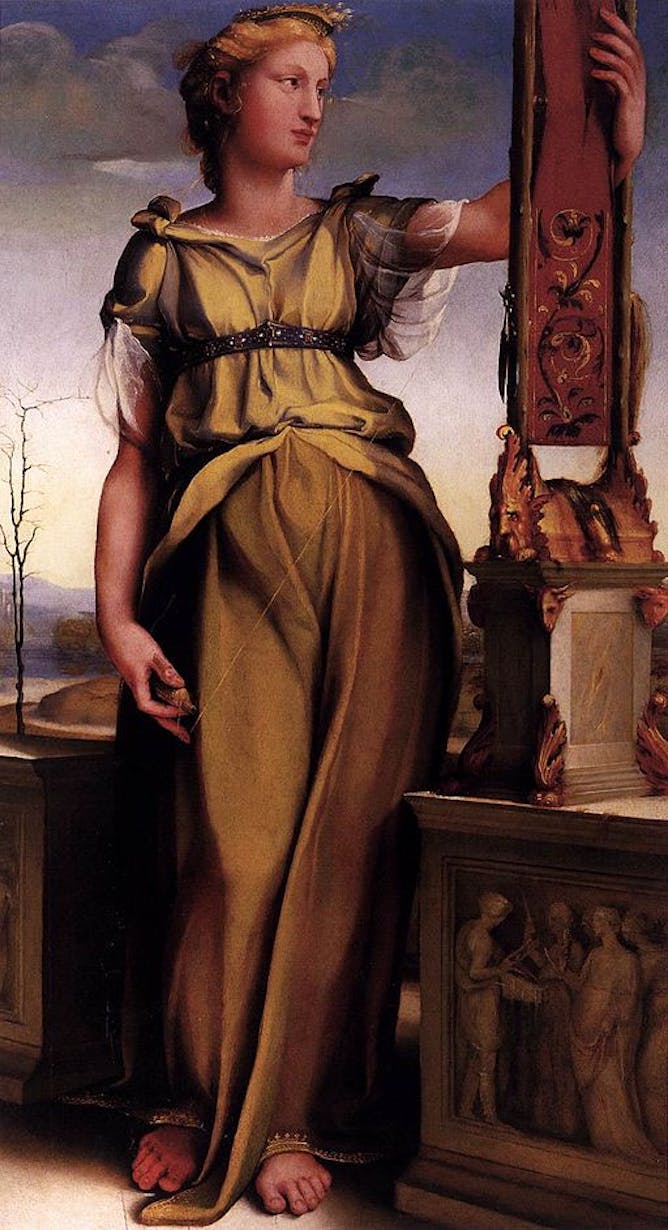
Just as Odysseus is too clever for the Trojans – and the suitors – so his wife Penelope is a model of cleverness and circumspection. She tries to avoid re-marriage and delays the event by a clever ruse: she agrees to marry a suitor only after she has finished weaving a death shroud for Odysseus’s father Laertes. The suitors agree to this, but little do they know that she weaves the shroud by day, and un-weaves it by night. She is eventually betrayed by one of the maids in the house, and forced by the suitors to complete it, although the ruse does last for three years.

Wikimedia
The Greeks had no illusion that the characteristic cleverness of Odysseus had a sinister aspect to it, not the least in the way that he deals with the Trojans after the war. Some of the atrocities at Troy, notably the killing of the young boy Astyanax (son of Hector and Andromache), are sheeted home to Odysseus by the poets. In late-5th century BC Athens (over 200 years after Homer’s Odyssey) the rise of demagogic politicians, like Cleon, seems to have affected the portrayal of Odysseus in Greek drama. In works such as Sophocles’ Philoctetes and Euripides’ Trojan Women the focus is on his appalling cruelty and duplicity. Likewise, the Roman poet Vergil in his Aeneid (Book 2) emphasises the dark trickery of Ulysses (the Roman name for Odysseus) in getting the Trojans to drag the Wooden Horse inside the city walls.
Returning from war
The Odyssey, therefore, is a maritime epic right up to the point where the focus of attention is the siege in Odysseus’s house. The return journey of the warrior from Troy was a favourite theme in Greek mythology, and we know of another early epic poem (simply called Nostoi, meaning “Returns”) which told a similar story. Even within the Odyssey there is a significant contrast between the careful and clever return of Odysseus, and that of Agamemnon, king of Mycenae, who is murdered as soon as he gets home.
There are a number of signs that the Odyssey is a later poem than the Iliad, and not necessarily by the same poet (despite the Greek tradition that they are both by “Homer”). The gods are far less prominent in the Odyssey than the Iliad, although Athena in particular has her moments. She is associated with cleverness (metis in Greek) and victory (nike), both of which are germane to the story of Odysseus’ survival, and that of his family. In many ways Odysseus and Penelope are models of the sorts of things that Athena represents.

Wikimedia
The Odyssey also has a more elaborate structure and chronology than the Iliad. The first four books deal with the situation of the house invasion on Ithaca, and the travels of the young Telemachus to mainland Greece. Athena takes Telemachus from the female space of the house to the outside world of male politics. Thereafter, Odysseus himself is the centre of the poem’s attention as wanderer, tale teller, and siege breaker in his own home. The folktale world through which he travels (in Books 9 to 12) is told indirectly by Odysseus on his journey home to a Phaeacian audience, rather than directly by the poet. This notion of Odysseus as tale teller is central to the Odyssey.
In many ways the Odyssey is the most renowned literary work from Greek antiquity, even though some people would say it lacks the radical brilliance of the Iliad. The fact that the word “odyssey” has come into our language from Homer’s poem speaks for itself. The story of the Odyssey is a quintessential quest that relates to the passage through life and the importance of love and family and home. Many readers today find the Odyssey more accessible and more “modern” than the “archaic” Iliad.
Modern interpretations
The rich variety of mythical narratives in the Odyssey (especially his wanderings through a world of wonder and mystery in Books 9 to 12) has meant that the cultural history of the poem is astonishingly large, whether in literature or art or film. Whole monographs have been written on the reception of Odysseus in later periods. When one bears in mind that Odysseus’s name at Rome, Ulysses, is often used by artists and writers, as it was by James Joyce, then we get a sense of how dominant a figure he is in western cultural history.
Creative re-tellings of the Odyssey in a modern context include films such as 2001: A Space Odyssey, Paris, Texas, and O Brother Where Art Thou? Likewise the theme of the returning war veteran has Homeric overtones in films like The Manchurian Candidate, The Deer Hunter and In the Valley of Elah.
Odysseus, moreover, probably influenced the early comic book superhero Batman in the late 1930s and 40s, just as Greek demigods, such as Heracles and Achilles, help to inform the extra-terrestrial background of Superman. As a human bat, Batman uses disguise to good effect, as Odysseus does, and he thrives on conducting his challenges in the darkness of night.
But the last word on the subject of Odysseus and his adventures should go to Bob Dylan, who won the Nobel Prize for Literature in 2016. Dylan wrote a lecture in honour of his Nobel victory, focused on some of the literature that influenced and affected him. One such work was the Odyssey, and with echoes of Constantine Cavafy’s magnificent poem Ithaca, Dylan reflects on Odysseus’ adventures and their immediacy as a lived experience:
In a lot of ways, some of these same things have happened to you. You too have had drugs dropped into your wine. You too have shared a bed with the wrong woman. You too have been spellbound by magical voices, sweet voices with strange melodies. You too have come so far and have been so far blown back. And you’ve had close calls as well. You have angered people you should not have. And you too have rambled this country all around. And you’ve also felt that ill wind, the one that blows you no good. And that’s still not all of it.
 Suggested translation: The Odyssey of Homer, Richmond Lattimore.
Chris Mackie, Professor of Classics, La Trobe University
This article was originally published on The Conversation. Read the original article.

 In doing so to connect the past with the present and to allow readers to recognise how much of their lives have changed and unavoidably, to pay attention to the many things, and ills, that remain the same. “Dancing the Death Drill” is a fine glimpse into this turbulent historical period in South Africa’s calendar and what is done with this narrative, as the cliché goes, is entirely up to the living.
 At the BookShelf
You must be logged in to post a comment.