
 The Handmaid’s Tale by Margaret Atwood
My rating: 1 of 5 stars
Not for me. A very boring and all over the place read. Other than that, I just didn’t like it. I won’t be reading the sequel.

The Handmaid’s Tale by Margaret Atwood
My rating: 1 of 5 stars
Not for me. A very boring and all over the place read. Other than that, I just didn’t like it. I won’t be reading the sequel.
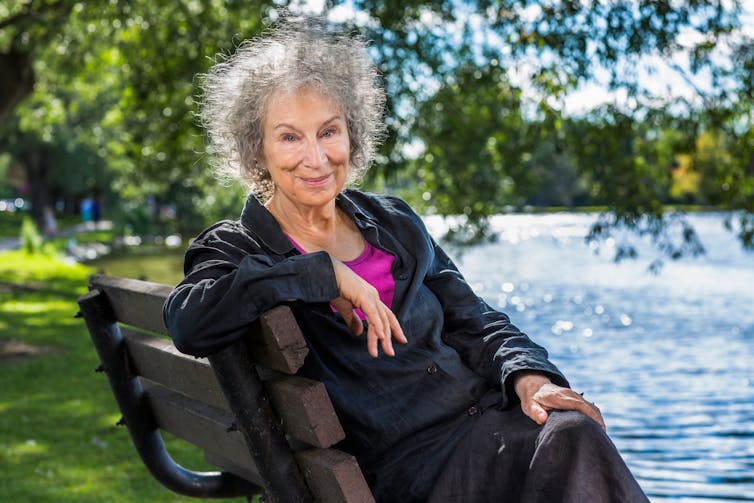
Camilla Nelson, University of Notre Dame Australia
The crimson cloaks and white bonnets of Margaret Atwood’s dystopian feminist classic The Handmaid’s Tale have become a distinctive feature of Trump’s America. They’ve been worn by protestors outside state legislatures across the country, as elected officials attempt to enact laws limiting women’s reproductive rights.
Let’s face it, there are few costumes in classic or contemporary literature that will immediately tell everybody exactly why you’re there. But for the unfamiliar, the cloaks are invariably accompanied by posters with slogans like “The Handmaid’s Tale is not an instruction manual” and “Make Margaret Atwood fiction again”.
Atwood’s dystopia was undoubtedly on the minds of the hundreds of people – nearly all of them women – who filled the concert hall at the Sydney Opera House on Sunday to listen to her speak. So eager were they to hear that the tickets to the talk hosted by UNSW’s Centre for Ideas sold out in a record 45 minutes.
Read more:
Why women are dressing up as Margaret Atwood’s Handmaids
The Handmaid’s Tale describes a toxic world in which misogyny and environmental degradation has turned the US into a totalitarian theocracy. The fictional republic of Gilead has enforced a system of gender-based violence, enslaving the few women capable of bearing children to serve as “handmaidens” to the ruling class.
In Gilead, lesbians and “gender traitors” are hanged. Citizens are tracked, watched, and spied upon. Women are not permitted to read. Children are torn from the arms of their birth mothers. There are deadly skirmishes at the borders, as refugees attempt to flee.
Little wonder so many critics have remarked on the unexpected parallels with the present – in a US in which a resurgence of threats to rollback women’s rights are accompanied by wider attacks on media freedom. News from the US border with Mexico – and from Australia’s detention centres – reads like something out of Atwood’s darkest imaginings.
It is tempting to stretch this looking-glass analogy to suggest the only substantive difference between The Handmaid’s Tale and our present moment is that environmental degradation is a pressing concern for the rulers of Gilead.
Atwood’s mind seldom runs in a straight line. It dances around what she wants to say – before skewering her point with a flash of dark humour. She recounted with affection some fashion advice from Dame Edna Everage about her hairstyle and – to the delight of her audience – actually sung. Then acknowledging the audience had possibly gathered to hear more about the “end of the human race”, said she would not delay them.
Control of women and children has been a feature of every repressive political regime on the planet and throughout history, Atwood told her audience. And oppression comes in many forms.
Writers write about the things that worry them. And Atwood’s work spans the major concerns of the century – climate change, species extinction, designer humans, the control and subjugation of women. Her work has been astonishingly adept at incorporating “each fresh hell” – as she calls them – as it arises.
And it was clear from the anxious laughter in the auditorium that the audience believed Gilead was already here – or at least, “there” in Trump’s America.
Atwood’s books paint a speculative or parallel reality. But she is careful to point out that they are also of their own historic moment. They contain nothing that has not already become part of what James Joyce once called the “nightmare of history” – no technology, no atrocity, “nothing goes on that has not already gone on”, she says.
She is also quick to insist that she is not a “prophet”. Atwood says – looking back on the Pollyanna decades of the 1990s – it could have gone the other way. She wished it had. We could have “all gone shopping” in Francis Fukuyama’s consumer capitalist utopia, she jokes. It would have been preferable.
Atwood is well known for her belief in the power of language to change things – something of an occupational hazard for writers. But she is also clear that words can obscure. They can damage. And they are often manipulated. “Who is going to decide how fake a piece of fake news is before it’s fake?”
One member of the audience claimed that she felt her whole life – from Ronald Reagan to Donald Trump – had been an experience of living through a series of “high literary dystopias”, lurching from atomic threat to species extinction.
Atwood had an answer for that, too. The solutions, says Atwood, will not come to you as novels.
They will also not be hers to find. She is – she claims – already an old lady who is arranging her own “environmentally friendly funeral”, without plastics.
Perhaps the reality is that in these dark times words are simply not enough. Words can be sharp instruments. They often seem to cut through a maelstrom to catch at the truth. But what we need is not just words, but also actions on a global scale. And so perhaps it’s time to don the cloaks and bonnets.
Camilla Nelson, Associate Professor in Media, University of Notre Dame Australia
This article is republished from The Conversation under a Creative Commons license. Read the original article.
Linda Wight, Federation University Australia
In 1985, Margaret Atwood’s dystopian novel, The Handmaid’s Tale, struck a chord with readers concerned about the conservative turn in US politics under President Ronald Reagan. The New Christian Right was leading the backlash against ‘60s and ’70s feminism. Three decades later, the novel’s enduring popularity suggests that such concerns have never fully abated. 
Earlier this year the book returned to bestseller lists, which Atwood attributed in part to concerns about the election of President Trump. In March, women donned the novel’s iconic red robes to protest bills proposed in the US that would infringe on fertility rights.
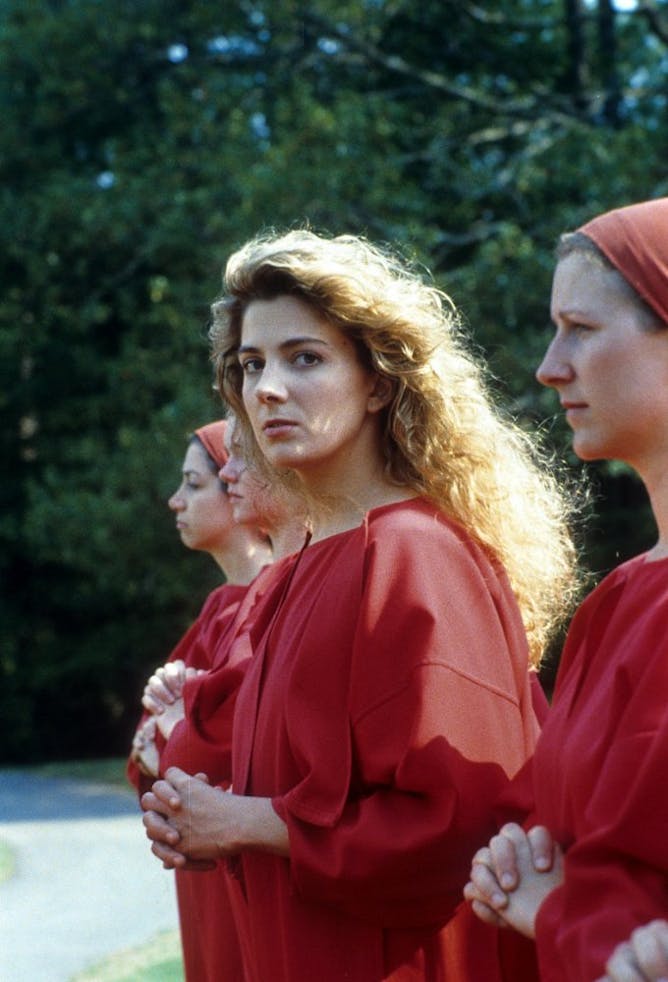
The Handmaid’s Tale has been the subject of numerous adaptations, including a 1990 film starring Natasha Richardson, as well as an opera, radio play, ballet and stage play. Most recently, the novel has been adapted into a 10-part television series starring Elisabeth Moss, to be released by Hulu this month.

Dystopian fiction, such as The Handmaid’s Tale, imagines a society worse than our own. While Atwood herself has called the novel an “anti-prediction”, it stands as a warning about where our own society might end up if individuals and communities fail to address similar dystopian tendencies in the present.
Atwood’s novel can be seen as a response to the 1980s backlash against the hard-fought gains women had secured in the 1960s and 1970s including increased participation in formerly male-dominated occupations, increased access to higher education, and the legalisation of abortion. Her interest in women’s experiences under a totalitarian regime distinguishes The Handmaid’s Tale from other classic dystopian fiction such as Aldous Huxley’s Brave New World (1932) and George Orwell’s 1984 (1949).
In The Handmaid’s Tale, set in the near-future, air and land pollution have led to a dramatic rise in sterility and babies being born with extreme physical abnormalities. A radical Christian conservative movement has staged a coup, shooting the US President and Congress and placing the blame on Islamic fanatics. This justifies declaring a state of emergency, suspending the constitution and censoring newspapers.

The radicals establish a Republic of Gilead in what was formerly Cambridge, Massachusetts. The theocratic military dictatorship uses the Old Testament and falling Caucasian birth rate to justify the extreme curtailment of women’s freedoms. Denied paid employment and the right to own property, women’s destiny is now determined by their reproductive potential, and assigned to several categories.
The Handmaids are women whose ovaries are still viable. Many have already proven their worth as “breeders” by giving birth to a healthy child. Reduced to their biological function, symbolised by the red habits they are forced to wear, Handmaids exist purely as breeding vessels. Each is the property of a male Commander, emphasised by their names. The narrator, Offred, is literally the property “of Fred.”
The Handmaids’ survival depends on conceiving a child. Denying the possibility that it is the men who are infertile, Handmaids who fail to conceive are shipped to the Colonies with other “Unwomen” to clean up toxic waste until they sicken and die.
Men who progress high enough in the hierarchy of Gilead are also assigned Wives (who wear blue) and Marthas (who wear green). Marthas, named after a Biblical character, serve as housemaids and cooks. Wives, who are usually sterile, enjoy a higher social status than both the Handmaids and the Marthas, but their lives are still subject to extreme restrictions including the ban on female literacy.
The Handmaid’s Tale is narrated by Offred, whose descriptions of her life as a Handmaid in Gilead are interspersed with memories of her previous life with her husband and daughter. Caught attempting to escape to Canada, Offred (we never discover her true name) was sent for re-education at the Handmaid Training Centre, and her memories are dominated by mourning for her lost family.
Despite such memories threatening to plunge her into despair, Offred recognises the crucial role they play in preventing her from completely succumbing to the control and demands of the new social system.

The male leaders of Gilead want women to forget their past freedoms, but Offred’s memories remind her that a different way of life is possible, and her loss and longing keeps alive her desire to resist the system that tore her family and identity away from her. Her memories of her Women’s liberation mother and feminist friend Moira are also crucial, inspiring Offred to her own small acts of resistance.
This makes The Handmaid’s Tale an example of a critical dystopia. As well as showing us how problems in the present can lead to a dark future, it also, crucially, insists that change is possible.
The Handmaid’s Tale includes an organised resistance movement which fights Gilead and smuggles escaped Handmaids and other subversives into Canada via an Underground Femaleroad (a nod to the Underground Railroad by which runaway black slaves escaped north in the early 19th century).
Offred herself is not a particularly active member of the organisation, though she does benefit from their intervention when her life is in danger. Nevertheless, she demonstrates her own form of resistance by seeking both knowledge and a voice in a system that would deny women either. Despite the best efforts of the Gilead elite to disempower women by segregating and silencing them, The Handmaid’s Tale celebrates the potential for female community and communication.
Such communication can have lethal consequences. The women’s determination to be heard, even if only in whispers, is a celebration of courage in the most extreme of circumstances. Finding a mock-Latin message, “Nolite te bastardes carborundorum” (“don’t let the bastards grind you down”) scratched in her cupboard by the Commander’s previous Handmaid, Offred reflects:
It pleases me to think I’m communing with her, this unknown woman … It pleases me to know that her taboo message made it through, to at least one other person.
The power of female storytelling is a central theme of the novel. Trapped in Gilead where women are prohibited from reading and writing, Offred nevertheless constructs her story in her mind. By imagining someone listening, she clings to the hope of a different world, a different life: “By telling you anything at all I’m at least believing in you, I believe you’re there, I believe you into being.”
By reading The Handmaid’s Tale, Atwood is making us a party to Offred’s resistance, emphasising our own responsibility to hear her words and heed her warnings.
The Handmaid’s Tale does not end in Offred’s voice. Instead, in a section titled “Historical Notes”, we are told that audio recordings of Offred’s story have been discovered two centuries later. These recordings are the focus of the Twelfth Symposium of Gileadean Studies; and a partial transcript of the proceedings forms the last word in the novel.
On the one hand the “Historical Notes” are reassuring and inspiring, suggesting that Offred made it out of Gilead, at least long enough to commit her memories to record, and revealing that the Republic of Gilead has long ago ceased to exist.
But the section also stands as a warning. Offred’s story is transcribed, annotated and published by two male academics, who refuse to give her story the status of official history and dismiss it as “crumbs”.
Offred herself acknowledged in her narrative that any historical account – including her own – can only ever be a partial reconstruction, even if the narrator has personally experienced the events:
It’s impossible to say a thing exactly the way it was, because what you say can never be exact, you always have to leave something out, there are too many parts, sides, crosscurrents, nuances; too many gestures, which could mean this or that, too many shapes which can never be fully described, too many flavours in the air or on the tongue, half-colours, too many.
Atwood emphasises that “official” versions of history are just as much a reconstruction. More importantly, they tend to dismiss women’s experiences and silence women’s voices in favour of so-called objective facts and figures. Offred’s voice is once again subjected to male control and critique.
The Professors’ weak puns and mockery at Offred’s expense, along with their reluctance to condemn those who oppressed such women, jar with Offred’s traumatic account of her struggle to survive in Gilead.
It’s a sting in the tail that asks us to think critically about the way women throughout history have been silenced, limited and consigned to the margins in numerous ways. Perhaps it is this insight that still speaks to so many readers, female and male alike, in the 21st century.
All quotations from the novel are from The Handmaid’s Tale published by Vintage Books in 2010.
Linda Wight, Senior Lecturer, Literature and Screen Studies, Federation University Australia
This article was originally published on The Conversation. Read the original article.
 At the BookShelf