Unknown's avatar

‘Coming of Age in Mississippi’ still speaks to nation’s racial discord, 50 years later


Leigh Ann Wheeler, Binghamton University, State University of New York

Most memoirs are soon forgotten.

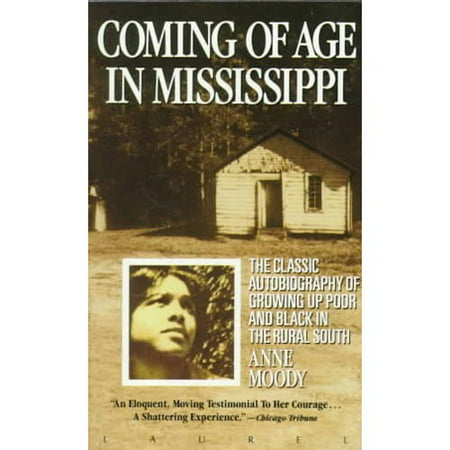
A rare exception is Anne Moody’s “Coming of Age in Mississippi,” which was published in 1968. It spoke to the day’s pressing issues – poverty, race and civil rights – with an urgent timeliness.

Fifty years later, the book still commands a wide readership. Read each year by thousands of high school and college students, it remains a Random House backlist best-seller – a title that continues to sell with little to no marketing.

As I research Anne Moody’s life for my upcoming biography, I often wonder what her memoir’s continued popularity means. Does it signal dramatic progress on race relations in the U.S. – or does it instead show us that, as former Sen. Ted Kennedy wrote in 1969, “If things are somewhat different, then they are not different enough.”

Till’s death opens Moody’s eyes

Written when Moody was 28 years old, “Coming of Age” is a gripping story. In spare, direct prose, she takes readers into the world of African-American sharecroppers in the Jim Crow South. As a child, she chopped and picked cotton, cleaned houses for white people, and wondered why whites had better everything – better bathrooms, better schools and better seats in the movie theater.

That mystery remained unsolved when, in 1955, Moody learned that white men had killed a black boy her age just a few hours’ drive north. The killing felt personal.

“Before Emmett Till’s murder, I had known the fear of hunger, hell, and the Devil,” she wrote. “But now there was … the fear of being killed just because I was black.”

Closer to home, whites ran her cousin out of town, brutally beat a classmate, and burned an entire family alive in their home. Amid such horrors, Moody feared a nervous breakdown.

But she resolved to resist.

In 1963, Moody became infamous in Mississippi after she challenged racial segregation in what would be the era’s most violent lunch-counter sit-in. At the Woolworth’s in Jackson, Mississippi, white men shoved Moody off her stool, dragged her across the floor by her hair and, when she crawled back, smeared her with ketchup, sugar and mustard.

Photographer Fred Blackwell captured a now-iconic image of this day, with Moody seated in the middle.
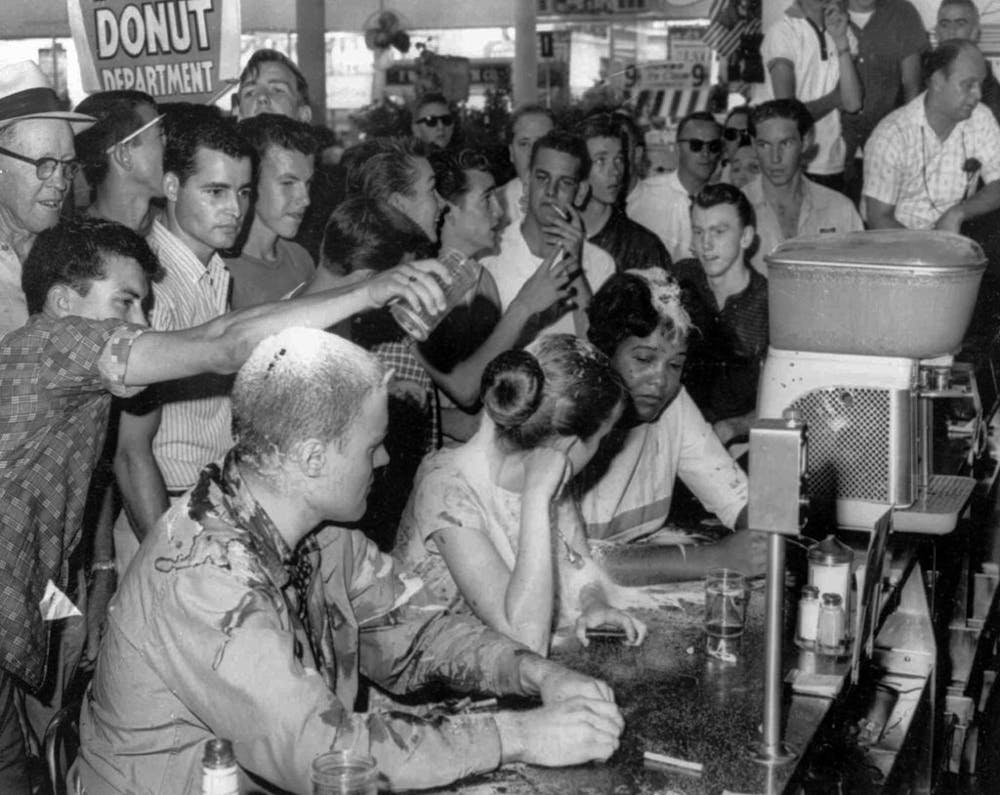
Anne Moody endures harassment from a crowd of whites at a Woolworth’s in Jackson, Miss.
Fred Blackwell/Jackson Daily News, via Associated Press

In the early 1960s, Moody worked tirelessly as an organizer for the Congress of Racial Equality in Canton, Mississippi. But after facing daily death threats, she fled to the North, where she moved from city to city, raising money for the movement.

At each stop, she described what it was like to come of age, as a black woman, in Mississippi. At one, she shared a stage with baseball great Jackie Robinson, who urged her to write down her story.

So she did.

Readers react

After “Coming of Age in Mississippi” was published, the response was split.

Some readers viewed the book as – in the words of one reviewer for The New Republic – a “measure of how far we have come.” To them, the worst of racism was over, and Moody’s account served as a stark reminder of how bad things once were.
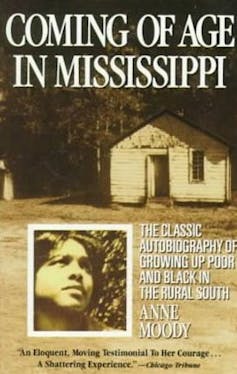
Many readers praised Moody’s story. Many in her home state, however, spurned it.
Dell

Others, however, read Moody’s experiences of racism as simply one chapter in a current and ongoing struggle – “the sickening story of the way it still is for thousands who are black in the American South,” as Robert Colby Nelson wrote for The Christian Science Monitor.

Massachusetts Sen. Ted Kennedy read it both ways.

He called the memoir “a history of our time, seen from the bottom up, through the eyes of someone who decided for herself that things had to be changed.” Still, he regretted that the book did not mention recent advances, like the Voting Rights Act of 1965, which enabled the election of several black public officials in Moody’s own hometown.

Meanwhile, for decades, Southern media outlets and public institutions shunned “Coming of Age in Mississippi” and Anne Moody herself. Hostile whites in Moody’s hometown of Centreville, Mississippi even threatened to kill her if she ever returned.

How much has really changed?

By contrast, today, “Coming of Age” shows up on high school and college reading lists throughout the South, and Anne Moody appears among 21 authors pictured on the Mississippi Literary Map. Her crumbling childhood home sits on the recently renamed Anne Moody Street, and Anne Moody Memorial Highway now connects Centreville and Woodville, the town where she graduated from high school.

In Moody’s day, local public officials were all white. Now they more closely reflect the county’s 75 percent black population.

In 1963, Moody mourned the assassination of her beloved colleague, Medgar Evers, president of the state National Association for the Advancement of Colored People, and watched in horror as local whites refused to convict his murderer. Thirty years later, Byron De La Beckwith was finally convicted of homocide and imprisoned for life. Today, visitors who fly into the Mississippi state capital, land at Jackson-Evers International Airport.

These shifts make “Coming of Age” seem, to many readers, an inspiring account of survival, resistance and victory.

But to others, the book is anything but a triumphalist story. Instead, its lessons are grim: In retrospect, civil rights victories seem superficial, while the brutal poverty and racism Moody described endures.

Compared to whites, black people in the U.S. are more than twice as likely to die in infancy, three times more likely to be poor, three times more likely to be killed by police, five times more likely to be imprisoned and seven times more likely to be murdered. The Voting Rights Act of 1965 was gutted by a 2013 Supreme Court decision that emboldened states around the country to create new restrictions that prevent black citizens from voting.

Anne Moody was one of the lucky ones. She graduated from college, moved north and published a best-selling memoir.

But despite the accolades, television appearances, radio interviews and speaking engagements, she could never really escape Jim Crow Mississippi. It had deprived her of her family and a place to truly call home.

“Coming of Age” ends with Moody listening to civil rights workers sing the anthem, “We Shall Overcome.”

“I wonder,” she wrote. “I really wonder.”

Fifty years later, many of us are still wondering.The Conversation

Leigh Ann Wheeler, Professor of History, Binghamton University, State University of New York

This article is republished from The Conversation under a Creative Commons license. Read the original article.
Unknown's avatar

A fresh perspective on Tasmania, a terrible and beautiful place


File 20181008 72110 1yyz2k6.jpg?ixlib=rb 1.1
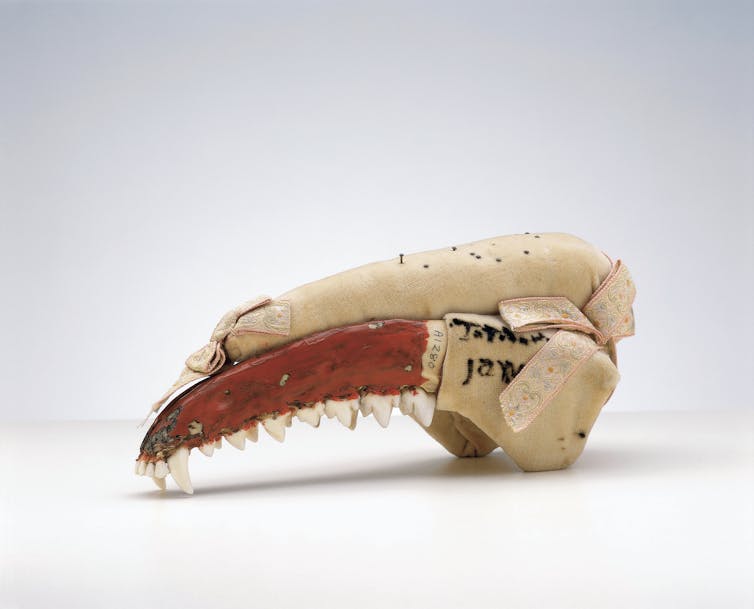
This pin cushion made from the jawbone of a thylacine won second prize in the handicraft section of the Glamorgan Show in 1900.
Courtesy Tasmanian Museum and Art Gallery

Cassandra Pybus, University of Tasmania

Book Review: Island Story: Tasmania in Object and Text.

The island of Tasmania lies suspended beneath Australia like a heart-shaped pendant of sapphire, emerald and tourmaline. Here is where the world runs out, crumbling into the vast expanse of the Southern Ocean.

Island Story: Tasmania in Object and Text offers us a fresh perspective on this terrible and beautiful place. Editors Ralph Crane and Danielle Wood invite the reader to discover Tasmania anew with their inspired juxtaposition of objects from the Tasmanian Museum and Art Gallery with texts as diverse as the objects. The pictures are arresting, the textual extracts are perfectly chosen and the design by Imogen Stubbs is gorgeous. Don’t be misled, this is no bland coffee table book.

As benefits such an ancient place, Island Story opens with the specimen of a hairy-legged cicada, an endemic species so ancient it was resident in the supercontinent of Pangea.


Read more:
Friday essay: journey through the apocalypse


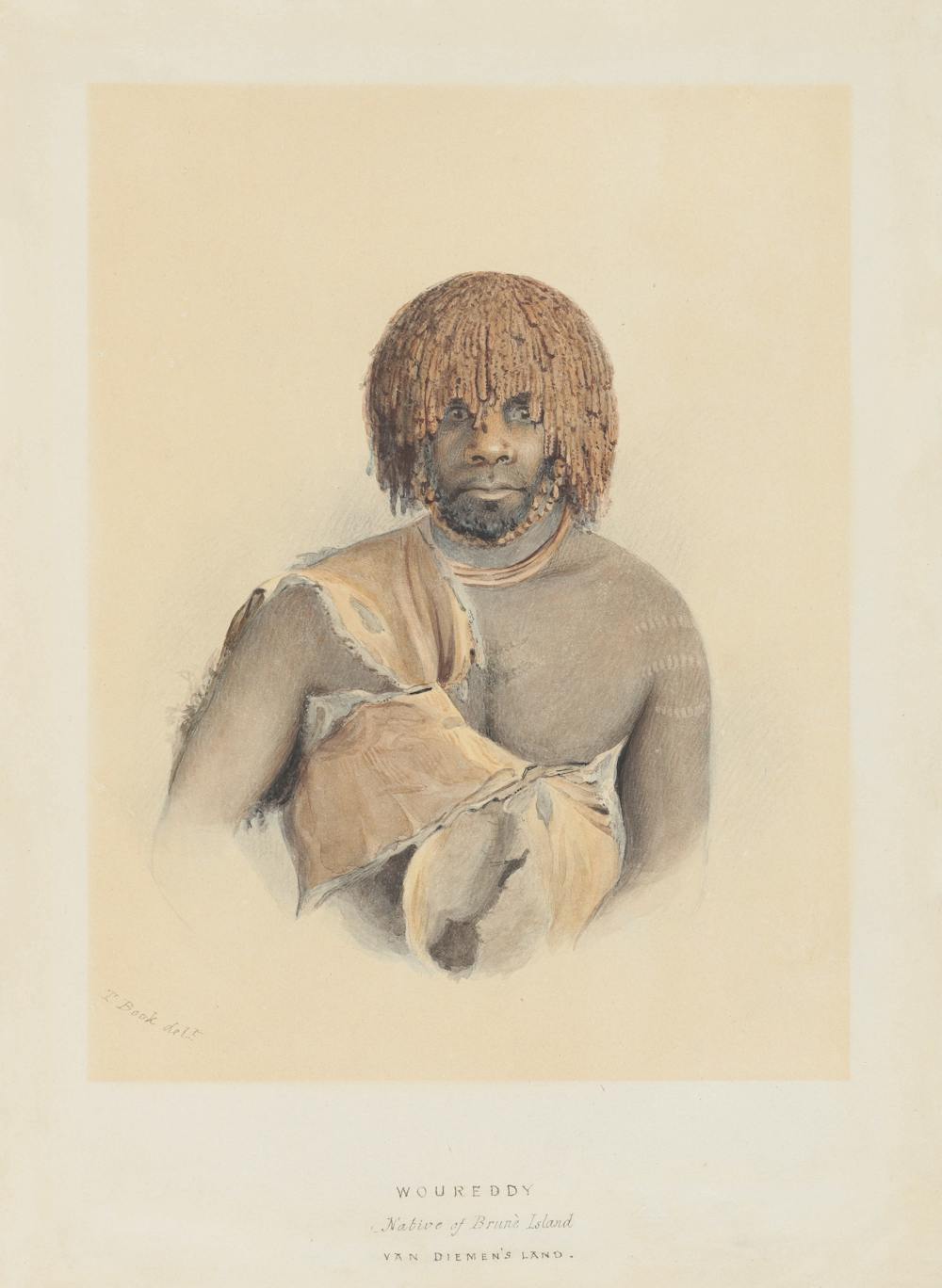
What follows is Thomas Bock’s 1837 portrait of Woureddy, cleverman and warrior of the original people of Tasmania, whose unbroken occupation of the island lasted 40,000 years until colonial invasion brought it to a dreadful end within the short span of Woureddy’s life.

Thomas Bock, Woureddy, Native of Bruny Island, Van Diemen’s Land.
Watercolour, 1837

Courtesy Tasmanian Museum and Art Gallery

Paired with the portrait is the befuddled interpretation of Woureddy’s narrative of the beginning of the world by George Augustus Robinson, the self-proclaimed evangelical missionary primarily responsible for the removal of all the original owners of the land to distant Flinders Island in the Bass Strait.

Robinson’s grand achievement in “conciliating” the original people of Tasmania was celebrated in an 1840 painting by Benjamin Duterrau, reproduced with a paired text by Greg Lehmann that puts in words an implicit theme of Island Story that “the spectre of genocide must be confronted and its consequences owned”.

Connections

The organising principle for the book is “the human desire to see, make and enjoy connections between seemingly disparate things”. A travelling case from the 1920s belonging to the silent move actress Louise Lovely, paired with an extract from Marie Bjelke Petersen’s novel Jewelled Nights that became a movie in 1925 starring Ms Lovely, seems unexceptional, but turn the page and there is a news photograph of arrests at the gay law reform protests in 1988.

The apparent disparity is resolved with the paired biographic extract by the gay rights activist Rodney Croome recalling his bizarre quest to shake the hand of the abhorrent Sir Joh Bjelke Peterson, favourite nephew of Marie, because his was the last hand to touch this writer Croome so admired.


Read more:
Churning the mud: Tasmania’s fertile ground for legal and social reform


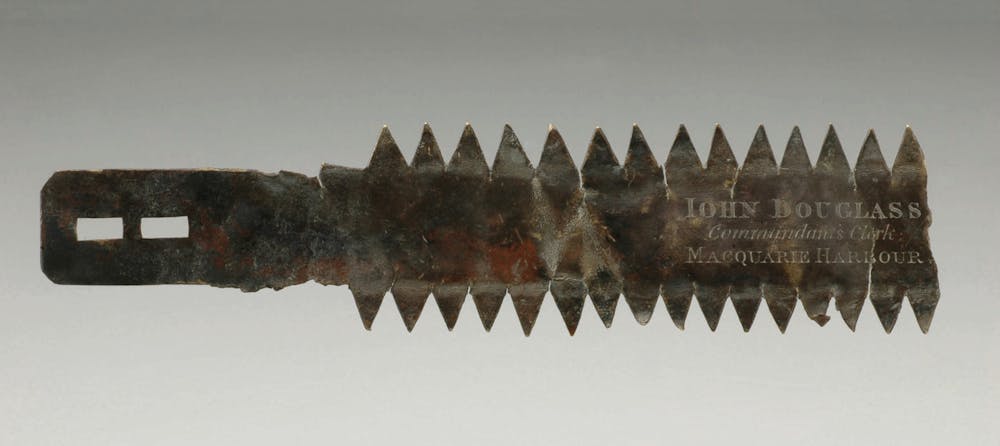
In my desire to see and make connections I found the dominant trope of this book to be captivity: entirely apposite for a place that began its modern history as prison. Among the more mundane objects is a saw from the infamous prison at Macquarie Harbour paired with historian Hamish Maxwell Stewart’s account of the extreme misery that drove so many fatal escape attempts.

John Douglas’s saw, c. 1830s.
Courtesy Tasmanian Museum and Art Gallery

Most chilling is the simple cambric and cotton hood with narrow eye slit for prisoners in the dreadful separate prison at Port Arthur. They had to pull it over their heads whenever they left their cell.

Convict Cowl, c. 1850.
Courtesy Tasmanian Museum and Art Gallery

In the paired extract from a travelogue by Anthony Trollope, a man who endured 40 years of frightful punishment at Port Arthur after being transported for mutiny, a boy tells Trollope: “I have tried to escape – always to escape – as a bird does out of a cage”.

A delicate watercolour of three young Hobart ladies by the gentleman painter and convicted forger Thomas Wainwright is paired with his 1844 petition begging he be released from “vice in her most revolting and sordid phase” that constituted his seven years in captivity.

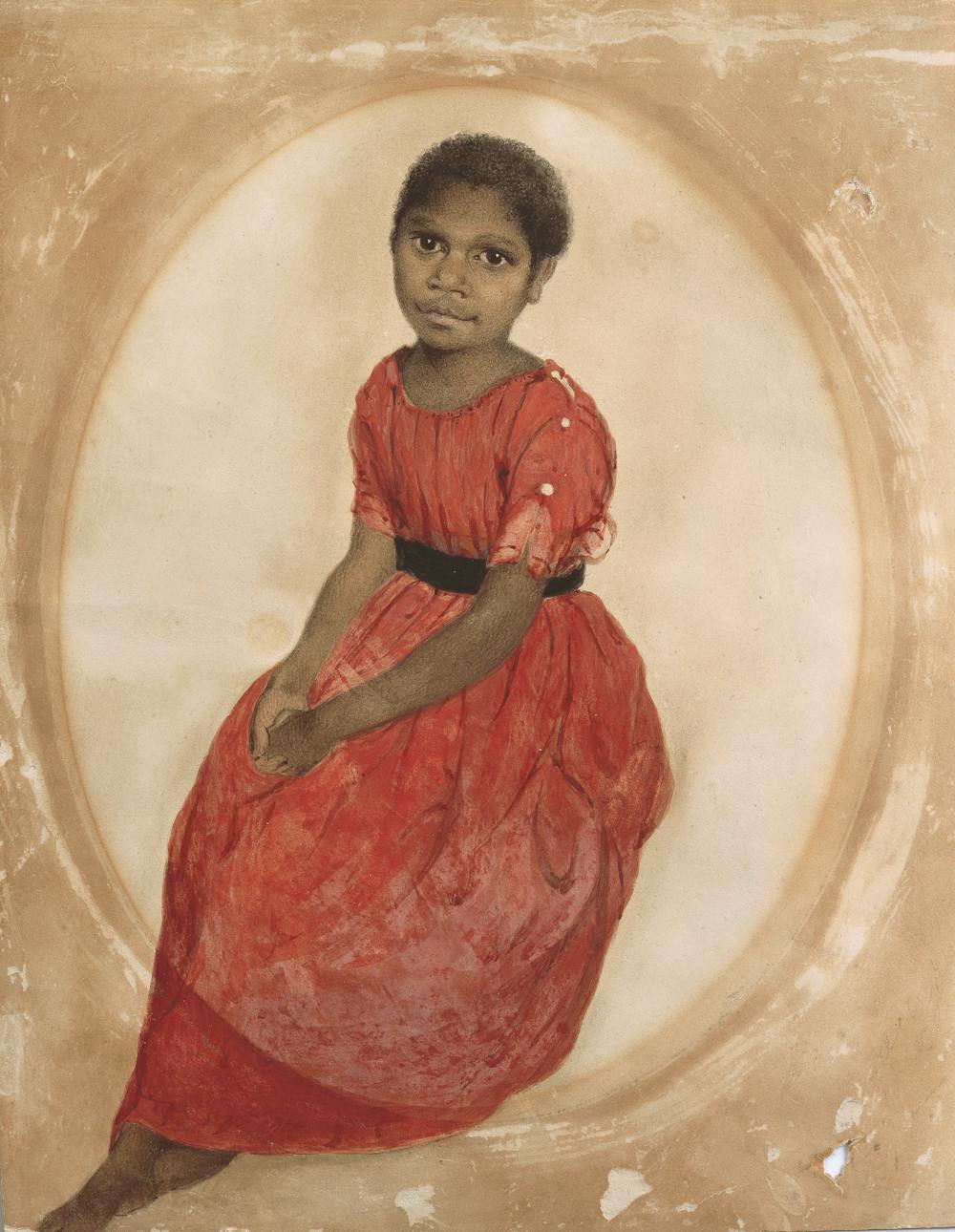
Thomas Bock, Mathinna, Watercolour, 1842.
Courtesy Tasmanian Museum and Art Gallery

The painter Thomas Bock also spent years as a convict. In addition to his portrait of Woureddy, the book reproduces his exquisite 1842 portrait of Mathinna, the young girl taken from captivity at Wybalenna on Flinders Island and sent to live at government house as a sort of household pet.

A recent photograph of the chapel at Wybalenna is paired with the 1846 petition to Queen Victoria from several young men protesting their unjust treatment at Wybalenna.

One year after the petition, four dozen survivors were transferred to another place of captivity at a disused convict station at Oyster Cove south of Hobart. All of those taken to Oyster Cove died, except for Fanny who had married an ex-convict named William Smith and went to live on land she was granted in the Huon Valley. She is represented here in the wax cylinders that captured her singing in her own language in 1899.

As one might expect, the extinct Tasmanian Tiger has several outings in this book: as a skeleton, a skin carriage rug and an exquisite jawbone pincushion that won second prize in the handicraft section of the Glamorgan Show in 1900. There is no still from the famous film of the last thylacine in his iron cage, but there is a poignant poem by Cliff Forshaw about the creature’s desolate pacing.

Thylacine Skin Buggy Rug, c. 1903, photographed by Robert David Stephenson.
Courtesy Tasmanian Museum and Art Gallery


Read more:
Friday essay: on the trail of the London thylacines


There are numerous other images from the Zoology section: a specimen drawer of impaled butterflies, stuffed wattlebirds imprisoned in a glass cabinet and a wombat taken from the wild around 1796 and kept in a cage at Government house in Sydney then preserved in spirits and sent to England where the taxidermist mistakenly set the animal standing upright.

Then there is John Burns, the fighting lion born in captivity in the Sydney Zoo and for many years displayed in a huge cage in a circus to be tamed by Captain Humphries and his whip.

Known for his morose moods and fits of rage, John Burns would thrill the audience with his fierce fight for supremacy over Humphries. His body was sent to the taxidermist and displayed in the museum diorama as a tableau with a lioness and two cubs in 1901.

The fighting lion was long gone by my childhood. What I remember of the diorama, which remained until quite recently, was a tableau of an Aboriginal warrior with his wife and two children sitting around a fire. This tableau was made of resin, you understand.The Conversation

Cassandra Pybus, Adjunct Professor in History, University of Tasmania

This article is republished from The Conversation under a Creative Commons license. Read the original article.